






Six to Eight weeks. We build AI incident response agents for your top 2–3 recurring production incidents, with measurable success criteria agreed in writing up front. Miss them, and you owe nothing further.
Generic AI incident automation tools demo well but stall on the incidents that actually matter. A pilot proves automation value on your real production patterns, with success criteria agreed before a single agent is built.
Tools promise everything, prove limited.
Generic AI SRE platforms demo well and stall on real production incidents. An incident automation pilot proves value on your actual patterns before you commit long-term.
Vendors cherry-pick easy wins.
Generic tools often skip the hard patterns. We target your top 2–3 recurring, expensive production incidents - the ones actually costing your team.
Months of investment, no measured result.
Most incident automation engagements start fuzzy and end in debate. Success criteria agreed in writing before the build make outcomes measurable from day one.
All the risk sits with you.
Pay up front, hope it works. With the pilot, if we miss the agreed criteria you owe nothing further and keep what we built.
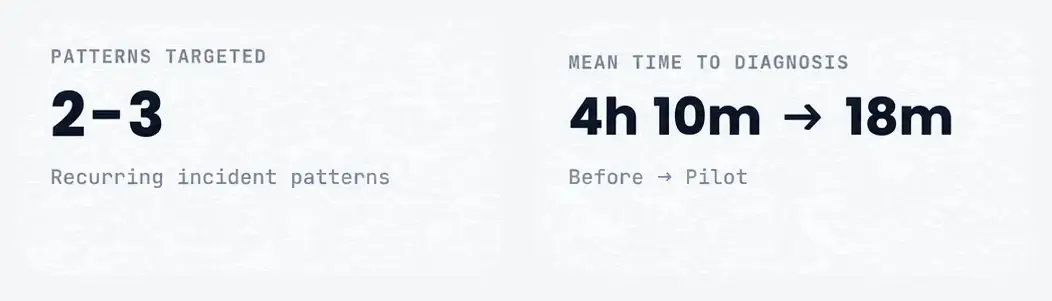
Working AI investigation agents for your top 2–3 recurring production incidents, using real telemetry in your environment. Success criteria are agreed before we build.
Working AI investigation agents for your top 2–3 recurring incident patterns, running against real production telemetry inside your environment.
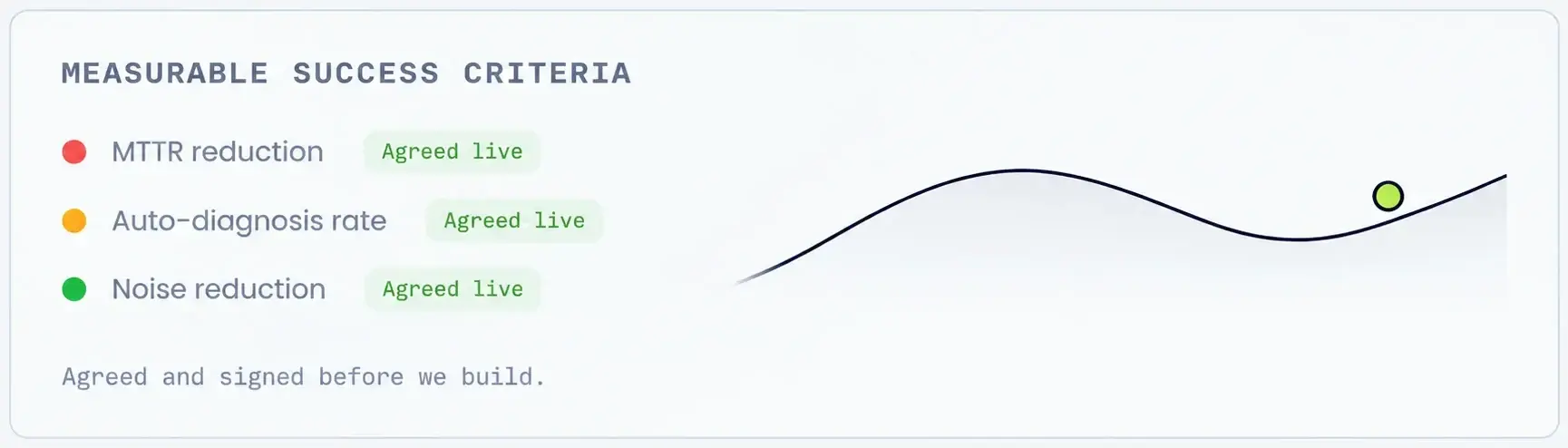
Measurable success criteria - MTTR reduction, auto-diagnosis rate, alert-noise reduction - agreed and signed before we build.
AI agents connected to Jira, PagerDuty, Slack and your observability stack - read plus guarded actions, scoped to exactly what you approve.
The tribal knowledge living in one engineer's head, turned into incident automation logic your whole team benefits from.
A measured comparison against your baseline - what changed in MTTR, engineering hours, and incident response cost.
A clear next step: scale to managed support, run the agents in-house, or stop - based on your incident automation results.
A low-friction AI incident automation pilot engineered for rapid validation and measurable ROI.
Talk to an AI SRE Expert
Whether you're evaluating AI incident automation or looking to automate recurring production incidents, our AI SRE specialists help identify the right approach based on your environment and goals.
The pilot is deliberately low-risk - here's why teams use us to validate AI-powered incident automation:
Target your top 2–3 recurring production incidents using your real production telemetry.
Agree on measurable outcomes such as MTTR reduction, auto-diagnosis rate, and alert-noise reduction before the build begins.
Deploy AI investigation agents inside your environment and connect them to Jira, PagerDuty, Slack, and your observability stack.
Compare results against your baseline to measure changes in MTTR, incident toil, and production support cost.
Three structured stages engineered to de-risk AI SRE adoption and validate measurable production automation ROI.
Billed fixed price · 2–3 weeks
Billed hourly · 6–8 weeks
Continuous 24/7 coverage
Hourly pricing for automation pilot with success criteria you agree in writing - before we build a thing.
Common questions about AI incident automation, our process, data safety, refunds, and deliverables.
From your assessment data (or a short discovery): recurring, expensive, well-instrumented production incidents where AI agents can make a measurable impact fastest.
We agree success criteria in writing before building. If the pilot misses them, you pay nothing beyond what's already agreed - and you keep the runbooks and findings.
Read access to your telemetry plus scoped, guarded actions you explicitly approve. Everything runs inside your environment.
It helps, and the fee is credited - but it isn't strictly required. We can run a short scoping instead.
Scale to Managed AI Production Support, keep running the agents in-house, or stop. Your call, no lock-in.