


AI SRE Expert. Specializing in Distributed Systems and Production Reliability
AI SRE is emerging as the operational layer between observability data and production action. In 2026, AI agents are increasingly used to gather evidence, correlate telemetry, investigate incidents, and recommend next steps across complex production environments. Explore the 2026 AI SRE market map, key trends, the DataTroops Agent SLI and Autonomy Budget frameworks, tool evaluation criteria, and a practical path from assessment to governed automation.
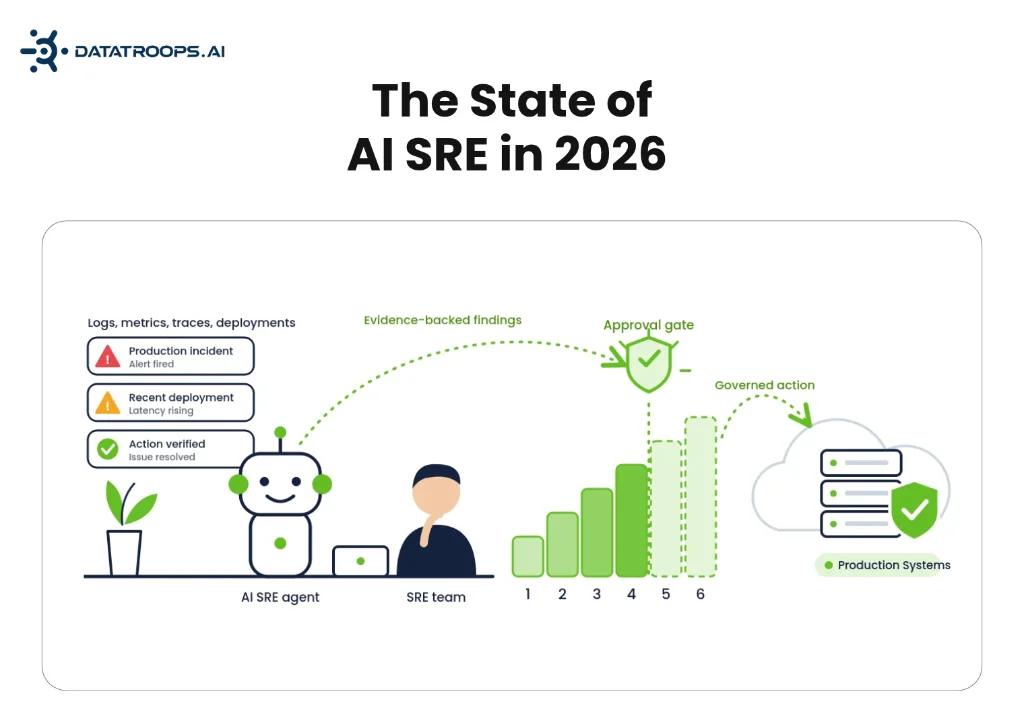
AI SRE is emerging as the operational layer between observability data and production action. In 2026, AI agents are increasingly used to gather evidence, correlate telemetry, investigate incidents, and recommend next steps across complex production environments. The technology is moving beyond alert summaries, but it is not synonymous with unrestricted autonomous remediation.
Most teams are starting with read-only investigation, incident enrichment, context gathering, and evidence-backed recommendations. High-impact production changes remain governed by permissions, approval workflows, verification, rollback, and escalation. The main constraint is no longer access to an AI agent. Reliable results depend on clean telemetry, accurate service ownership, current runbooks, useful incident history, and clear safety boundaries around automation.
AI SRE is the use of AI systems and agents to investigate, diagnose, recommend, and, within defined operational limits, help remediate production reliability issues. It combines traditional Site Reliability Engineering principles with observability data, incident workflows, operational knowledge, and governance controls.
In practice, an AI SRE workflow may gather logs, metrics, traces, recent deployment information, service topology, runbooks, tickets, and past incident history. It can then build an investigation timeline, identify relevant evidence, summarize likely contributing factors, recommend a next step, or trigger a bounded workflow that has been approved in advance.
AI SRE is not simply a chatbot connected to logs. It is also not a replacement for observability platforms, SRE teams, or operational accountability. The value comes from connecting fragmented operational context and using it within a controlled system of permissions, verification, recovery, and escalation.
AIOps remains an important foundation for event correlation, anomaly detection, and alert reduction. AI SRE builds on that foundation by using broader operational context to help teams understand what happened, what evidence supports the explanation, and what action may be safe to take next. The categories overlap, and vendors may describe similar functionality as AIOps, AI observability, incident intelligence, agentic operations, or AI SRE.
| Capability | AIOps | AI SRE |
|---|---|---|
| Primary focus | Event correlation, anomaly detection, and alert reduction | Investigation, diagnosis, evidence gathering, and governed action |
| Typical data | Metrics, logs, alerts, and events | Telemetry plus deployments, topology, code context, tickets, runbooks, and incident history |
| Typical output | Alert grouping, anomaly signals, and event correlation | Evidence-backed hypotheses, next steps, and controlled remediation |
| Automation model | Rules, workflows, and correlation engines | Agentic reasoning combined with policy-controlled execution |
| Human role | Review alerts and execute workflows | Validate evidence, approve high-impact actions, and govern agent behavior |
| Risk boundary | Operational noise and event management | Production permissions, action safety, verification, and recovery |
AI SRE does not yet have one universally accepted market definition. Some analysts include only AI-native reliability agents. Others include AIOps, observability platforms with AI capabilities, incident-management platforms, cloud operations tooling, or managed services. This is why published market-size estimates may differ widely without necessarily measuring the same thing.
Before comparing market figures, readers should check the source’s category definition, base year, geographic coverage, revenue categories, research method, and forecast period. For engineering leaders, the more useful question is not simply how large the category is. It is which parts of the reliability workflow AI can improve in their environment, and what controls are required before the agent receives broader authority.
| Category | Typically includes | May exclude |
|---|---|---|
| AI-native SRE | Agentic incident investigation and bounded remediation | Broad monitoring-only tools |
| AIOps | Event correlation, anomaly detection, alert intelligence | Deep agentic investigation or remediation |
| AI observability | AI-assisted analysis inside observability platforms | Incident workflow orchestration |
| Incident intelligence | Paging, response coordination, summaries, postmortems | Infrastructure-level diagnosis |
| Managed AI SRE | Technology, implementation, workflow design, and operations support | Pure SaaS-only revenue |
The AI SRE market is best understood as a reliability stack rather than a single product category. Different layers collect operational data, detect and interpret system behavior, coordinate incidents, investigate potential causes, execute approved remediation, and provide the people and operating model required to make the technology useful.
The following map is functional, not a ranking. Vendors may operate across multiple layers, and their capabilities can change quickly. Individual product inclusion should be validated against current first-party documentation before publication.
| Layer | Primary role | Typical capabilities | Representative categories |
|---|---|---|---|
| Telemetry foundation | Collect operational data | Metrics, logs, traces, events, service topology | OpenTelemetry, Prometheus, Grafana |
| Observability intelligence | Detect and explain system behavior | Anomaly detection, correlation, topology, AI assistance | Observability platforms and cloud monitoring tools |
| Incident coordination | Manage response workflows | Paging, escalation, incident rooms, postmortems | Incident-management platforms |
| AI investigation | Gather evidence and propose diagnoses | Log analysis, deployment correlation, runbook retrieval, root-cause hypotheses | AI-native SRE agents and observability-native assistants |
| Governed remediation | Execute approved actions safely | Policy checks, allowlisted runbooks, rollback, verification | Cloud automation, workflow systems, platform tooling |
| Services and managed operations | Make AI SRE operational | Assessment, integration, workflow design, governance, managed support | Specialist implementation and managed-service providers |
AI is moving beyond alert classification and event correlation toward multi-step evidence gathering, incident investigation, and recommendation workflows. Instead of asking an engineer to manually move across dashboards, logs, traces, deployment records, tickets, and runbooks, an agent can assemble a timeline and surface the evidence most relevant to a responder.
However, correlation is not proof of root cause. A reliable AI SRE workflow should show the evidence behind its conclusion, identify uncertainty where appropriate, and make it easy for an engineer to validate or reject the recommendation. Buyers should ask whether a tool provides traceable evidence rather than only a confident-looking summary.
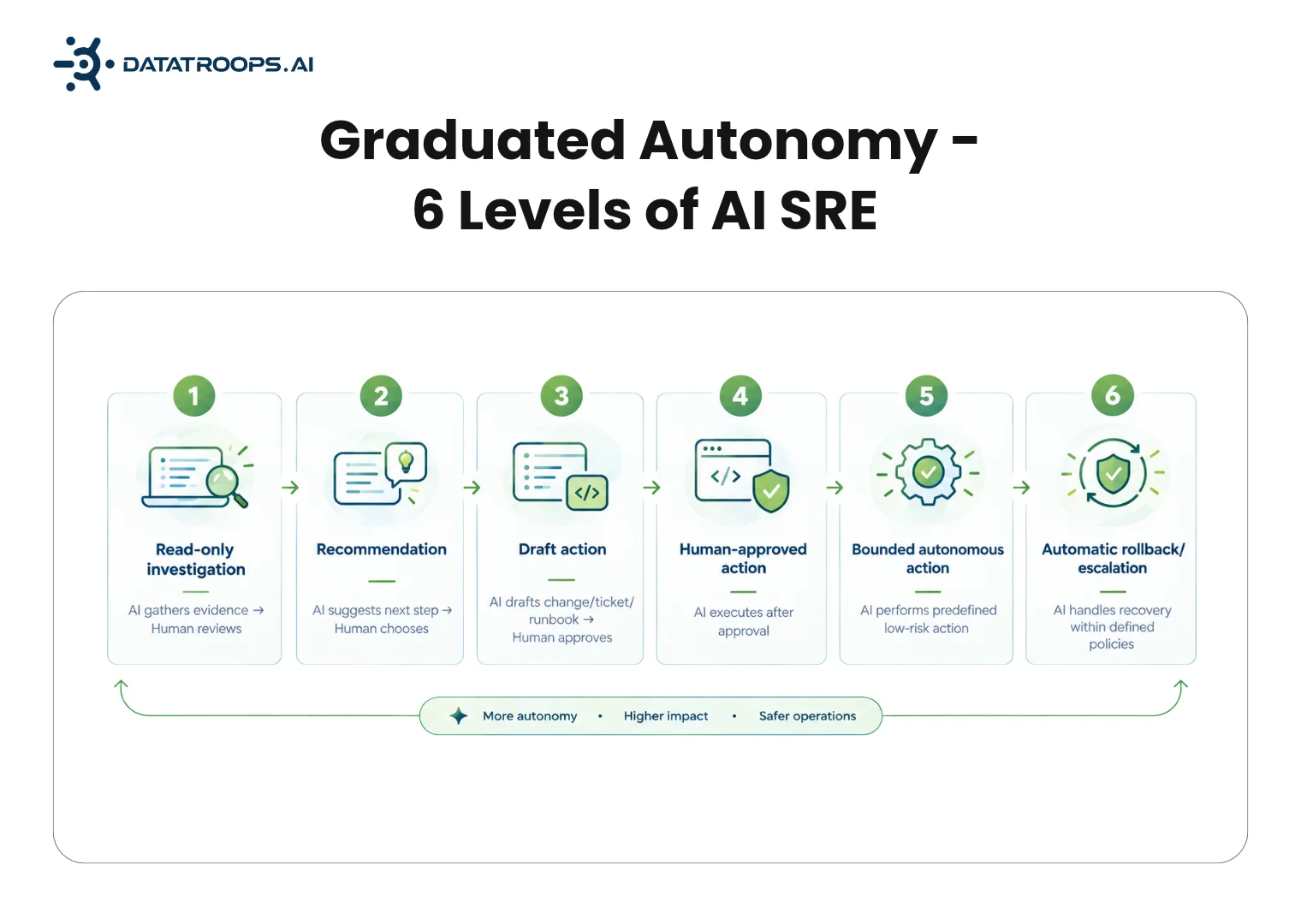
Graduated Autonomy: 6 Levels of AI SRE
Most organizations are not moving directly from manual operations to fully autonomous remediation. They are increasing an agent’s authority gradually, based on the action’s risk, the quality of the available evidence, the existence of rollback, and the agent’s demonstrated performance over time.
| Level | Agent capability | Human role |
|---|---|---|
| 1 | Read-only investigation | Review findings and evidence |
| 2 | Recommendation | Choose the next step |
| 3 | Draft change, ticket, or runbook | Review and approve before execution |
| 4 | Human-approved action | Authorize a production change |
| 5 | Bounded autonomous action | Review outcomes and handle exceptions |
| 6 | Automatic rollback or escalation | Own policies, safeguards, and post-incident learning |
A mature platform should support different permission levels by action type, environment, service criticality, and blast radius. Read-only investigation should not automatically grant an agent the ability to change production systems.
Reliability teams increasingly need to monitor more than traditional application availability. AI systems introduce new operational dependencies: inference latency, token and compute consumption, GPU capacity, model or prompt changes, data-pipeline health, output quality where measurable, agent tool calls, and coupling between model versions and infrastructure versions.
The operational challenge is cross-layer visibility. A change in a model, prompt, workload profile, GPU allocation, upstream data source, or tool integration may become visible to users as higher latency, lower throughput, unexpected outputs, or application errors. AI SRE needs to connect those signals rather than treating model, infrastructure, and application reliability as separate problems.
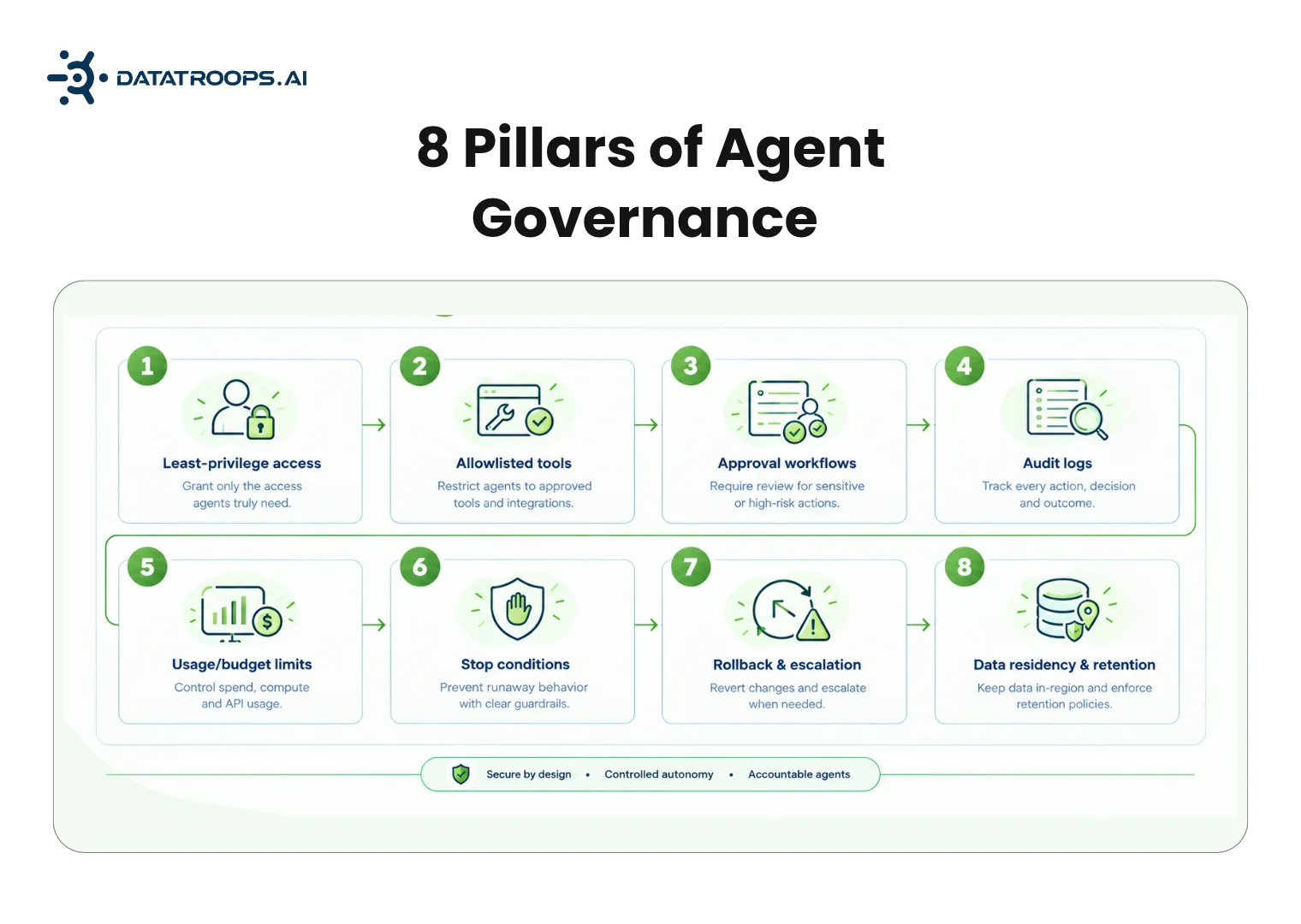
8 Pillars of Agent Governance
As agents gain access to operational tools, identity, permissions, tool boundaries, data handling, and auditability become production-reliability concerns. The risks are not limited to an incorrect diagnosis. They also include excessive permissions, unsafe tool use, injected instructions in logs or tickets, unintended data exposure, runaway costs, and changes that cannot be easily reversed.
AI does not eliminate the need for SRE expertise. It shifts more responsibility toward designing operational context, maintaining reliable runbooks, evaluating agent behavior, governing actions, and improving recovery systems. Engineers still need to decide what counts as acceptable evidence, which actions are safe, when automation should stop, and how the organization learns after an incident.
The emerging role is less about manually collecting every piece of context and more about creating the conditions in which both people and agents can make reliable decisions. That includes service ownership, telemetry standards, dependency mapping, operational documentation, policy-as-code, and controlled recovery workflows.
AI SRE can reduce repetitive context gathering, accelerate incident investigation, and support more consistent operational workflows. But results vary significantly based on telemetry quality, environment complexity, operational maturity, model behavior, and the authority granted to the agent. A successful product demo is not sufficient evidence that an agent is ready to make unattended production changes.
Teams should interpret industry surveys and vendor case studies carefully. Different studies use different populations, questions, time periods, and definitions of adoption or success. Reported improvements in toil, incident response, or developer productivity may be meaningful, but they do not automatically transfer to every production environment.
| What to evaluate | Why it matters |
|---|---|
| Investigation quality | A fast answer is not useful if it lacks evidence or misses the actual cause |
| Escalation behavior | The agent should know when uncertainty or risk requires a human |
| False confidence | A plausible but unsupported recommendation can be more dangerous than no recommendation |
| Action verification | A completed workflow does not prove the production issue is resolved |
| Recovery behavior | The system needs a safe way to stop, roll back, or escalate if conditions worsen |
| Operational cost | The value of AI assistance must justify model, integration, and maintenance costs |
AI may make teams faster at correlating operational signals. Faster correlation is not automatically the same as correct root-cause analysis or safe remediation. The most credible implementations treat AI as part of a measured, governed operating system rather than as an independent decision-maker.
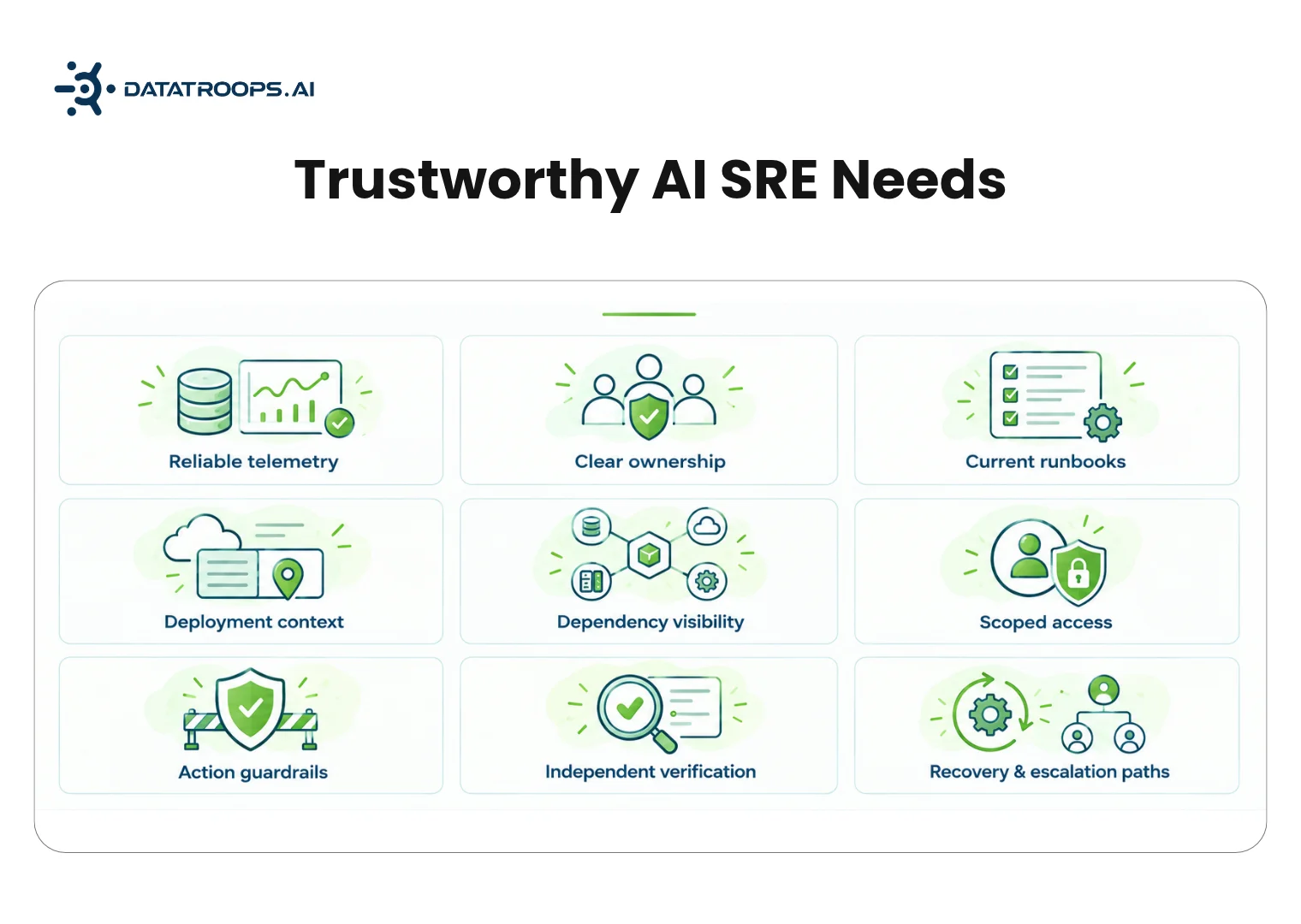
Key Foundations for Trustworthy AI SRE Operations
As core agent capabilities become more widely available, the differentiator shifts toward whether an organization has the context and controls required to trust the agent. An AI SRE agent can only work with the telemetry, documentation, permissions, and operational history available to it. If service ownership is unclear, runbooks are stale, topology is incomplete, or incidents are poorly documented, the agent will inherit the same uncertainty as the human responder.
A trustworthy AI SRE workflow depends on:
The following are DataTroops’ proposed Agent Service Level Indicators. They are not industry standards, but they provide a practical way to evaluate whether an AI SRE workflow is becoming more trustworthy over time.
| Agent SLI | What it measures |
|---|---|
| Time to first relevant evidence | How quickly the agent gathers context that helps a responder |
| Investigation completion rate | How often the agent produces a usable investigation rather than stopping without a meaningful result |
| Escalation rate | How often the agent correctly recognizes that a human needs to take over |
| False-confidence rate | How often the agent makes unsupported or incorrect claims with high confidence |
| Diagnosis accuracy | How often the validated root cause matches the agent’s findings |
| Human override rate | How often a human changes the recommended next step |
| Verification success rate | How often a completed action is confirmed to have produced the intended outcome |
| Cost per investigation | Whether the workflow is economically viable at operational scale |
An autonomy budget means an agent earns permission by action class, environment, and demonstrated reliability. A safe read-only investigation does not automatically justify production write access. Authority should depend on reversibility, blast radius, service criticality, evidence confidence, historical success rate, and the availability of rollback.
For example, an agent may be allowed to summarize alerts and retrieve runbooks across all environments, draft a remediation plan for a staging environment, require explicit approval for a production restart, and be prohibited from modifying critical infrastructure without a formal change process. This model makes authority a measurable, revocable operational decision rather than a binary setting.
Do not evaluate AI SRE tools only through a polished demo. A meaningful evaluation should use real historical incidents or a bounded production workflow, begin with read-only data access, define success criteria in advance, and measure evidence quality as well as speed. The objective is not to prove that the agent can generate an answer. It is to prove that the answer improves operational decisions safely.
| Evaluation area | Questions to ask |
|---|---|
| Evidence quality | Does the system show the logs, metrics, traces, changes, or runbooks behind its conclusion? |
| Investigation coverage | Can it use telemetry, deployments, topology, tickets, documentation, and incident history? |
| Read-only default | Can the team start without granting write access to production? |
| Permission scope | Can access be limited by service, environment, tool, and action type? |
| Action governance | Are actions allowlisted, approval-gated, and policy-controlled? |
| Verification | Does the system check whether a remediation actually worked? |
| Recovery | Can workflows stop, roll back, or escalate if conditions worsen? |
| Auditability | Are agent inputs, tool calls, recommendations, approvals, and actions logged? |
| Evaluation | Can the team test the agent against historical incidents before production use? |
| Cost model | Is pricing based on users, telemetry, incidents, investigations, actions, or outcomes? |
| Data handling | Are data residency, retention, isolation, and model-training policies clear? |
The right AI SRE approach depends on the organization’s platform maturity, integration needs, risk tolerance, budget, and ability to operate the system over time. There is no universal best path.
| Approach | Best for | Advantages | Trade-offs |
|---|---|---|---|
| Buy a platform | Teams seeking faster adoption and a supported product | Faster access to capabilities, vendor support, lower maintenance burden | Less control over behavior, integrations, or roadmap |
| Build in-house | Large platform teams with unique workflows and strong internal capability | Maximum customization and internal control | Higher engineering, evaluation, governance, and maintenance cost |
| Use a managed service | Teams needing help with adoption, workflow design, and operational execution | Specialist expertise, faster operationalization, support across mixed tooling | Requires clear ownership, scope, and governance arrangements |
DataTroops is most relevant when a team does not only need another AI tool. It needs help understanding production-support patterns, improving operational context, selecting safe workflows, integrating systems, defining controls, and measuring whether automation is producing a real reliability benefit.
Begin with read-only access to incident, observability, and operational data. The objective is to understand recurring incident patterns, time spent on diagnosis versus remediation, alert noise, repeated L1 and L2 workflows, missing context, and candidate workflows that may be safe to automate.
Choose a workflow with clear inputs, known failure modes, a limited blast radius, documented runbooks, measurable success criteria, and human approval for production changes. Suitable first pilots often include alert enrichment, incident context gathering, deployment correlation, runbook recommendation, ticket drafting, postmortem drafting, or low-risk investigation workflows.
Define the rules before allowing an agent to take action:
Track whether the pilot is producing better operational outcomes:
Scale only when the agent consistently produces useful evidence, correctly recognizes when to escalate, operates within the defined safety boundaries, and demonstrates acceptable cost and reliability for the workflow in question.
AI SRE is becoming less about adding an AI assistant to an incident channel and more about designing a trustworthy operating model around AI-assisted investigation and controlled action. The most valuable capabilities are not simply faster summaries or more autonomous workflows. They are complete operational context, evidence-backed findings, clear permission boundaries, independent verification, and safe recovery paths.
Teams that begin with read-only investigation and bounded pilots can learn where AI adds value before granting broader authority in production. DataTroops helps teams take that path: understand where production-support time goes, identify repeatable investigation workflows, improve the context available to operators and agents, and introduce automation with appropriate governance.
Start with a Production Health Assessment to identify where AI-assisted investigation and controlled automation can create the most value.
Start with a Production Health Assessment to identify where AI-assisted investigation and controlled automation can create the most value.
Key takeaways and architectural details Settled for engineers and team leads.
AI SRE uses AI systems and agents to help teams investigate, diagnose, recommend, and, in controlled cases, remediate production reliability issues. It combines observability data, incident workflows, operational knowledge, and governance controls.
AIOps often focuses on alert correlation, anomaly detection, and event intelligence. AI SRE builds on those capabilities by helping teams investigate incidents with broader context and, within defined boundaries, coordinate or execute governed actions.
They can perform bounded, low-risk actions when permissions, policies, verification, and rollback procedures are in place. High-impact production changes should usually remain human-approved until the organization has strong evidence that the automation is reliable.
Useful inputs may include metrics, logs, traces, events, service topology, deployment history, configuration changes, runbooks, tickets, and past incidents. The agent’s usefulness depends on the completeness, accuracy, and accessibility of that context.
Teams should track evidence quality, diagnosis accuracy, escalation rate, human override rate, verification success, false-confidence rate, and cost per investigation. Agents should first be tested against historical incidents and bounded real-world workflows.
The right path depends on internal platform maturity, integration needs, budget, and operational capacity. Buying may accelerate adoption, building may offer more control, and managed services can help teams implement governance and workflows while improving their operational context.
Pricing models vary widely and may be based on users, data volume, incidents, investigations, actions, or infrastructure usage. Teams should assess total cost, including implementation, integration, governance, telemetry quality, evaluation, and ongoing operational ownership.
Deploy autonomous agents inside your environment to investigate alerts, diagnose incidents, and generate verified fixes.