


AI Agents & Enterprise Automation Specialist
Enterprise AI security treats every model and agent as an untrusted insider - wrapping LLMs, agents, and MCP integrations in least privilege, identity verification, and runtime inspection, then governing them against frameworks like NIST, OWASP, MITRE, ISO 42001, and the EU AI Act.
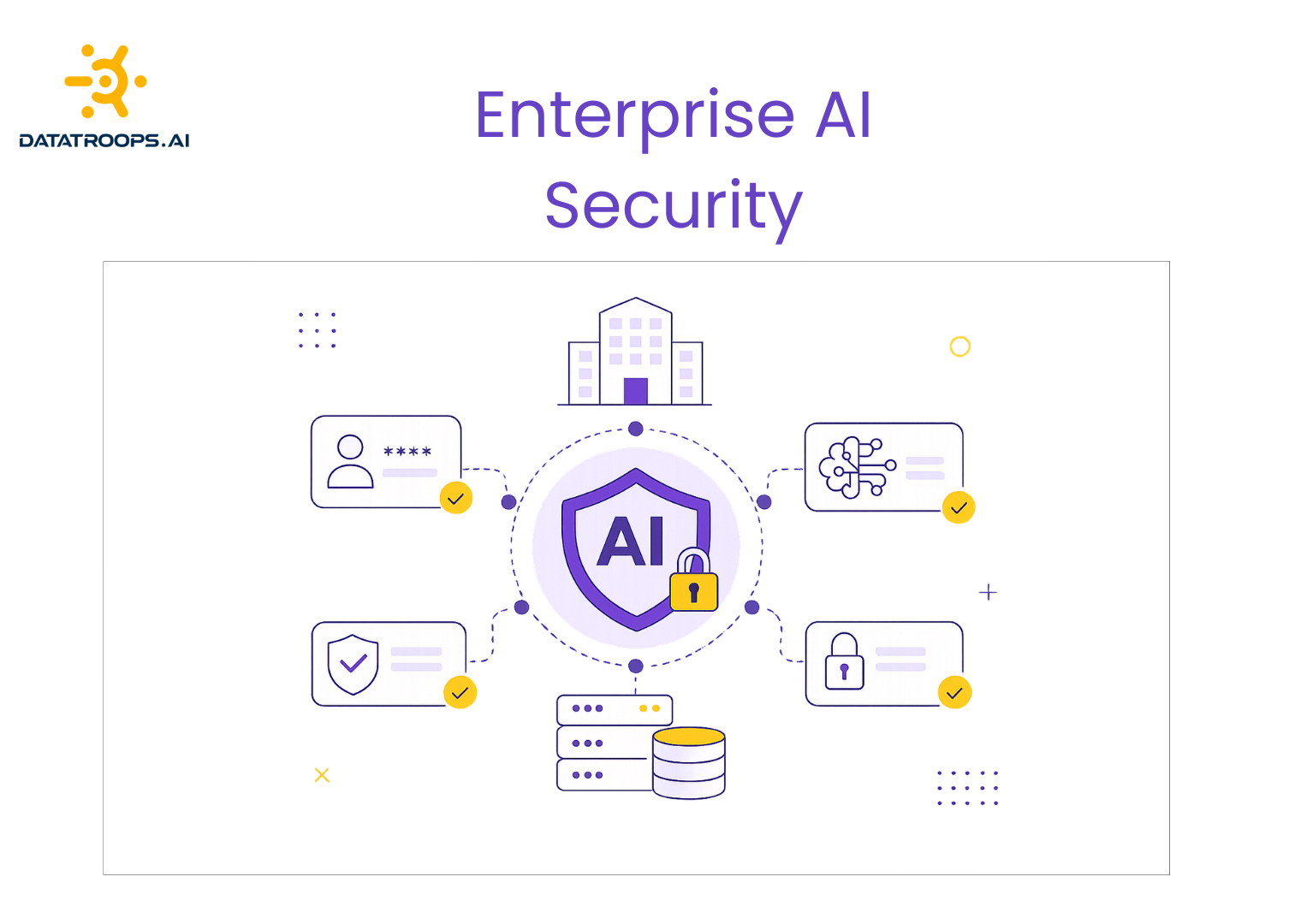
The one-sentence thesis: Treat every model and agent as an untrusted insider. Wrap it in least privilege, identity, and runtime inspection - then govern it. Everything below is the why and the how.
Enterprises are shipping LLMs and autonomous agents faster than they are securing them. The result is a new, poorly understood attack surface where natural language is the exploit, your own AI can be turned against you, and a single compromised agent can move money, delete data, or leak your crown jewels - sometimes with zero human interaction.
This is a no-sugarcoating field guide. There is no silver bullet for the biggest risks. What follows is what actually holds up in production.
An attack surface is every point where an attacker might gain access. Traditional software expanded it with ports, APIs, and dependencies. AI blows it wide open: every prompt, tool, plugin, memory store, connected data source, and other agent becomes an entry point. The more capability you grant your AI, the more an attacker can do through it.
Prompt injection is the AI era's equivalent of SQL injection - and OWASP ranks it the #1 risk for LLM applications. The mechanism is identical; only the language changed.
| SQL Injection | Prompt Injection |
|---|---|
| Attack via symbols & syntax. Insert special characters so the query returns every account instead of one. | Attack via natural language. "Ignore previous instructions." "Pretend you're someone else." The model can't separate instruction from data. |
| Fix: parameterised queries cleanly separate code from data. | No complete fix exists - natural language is the interface. You contain it; you don't cure it. |
No sugarcoating: Any vendor claiming to "solve" prompt injection with a single filter is selling false confidence. You mitigate it with architecture - least privilege, isolation, and monitoring - not with a magic classifier.
Indirect injection is the enterprise nightmare because it needs zero access to your systems. The attacker just places poisoned text where your AI will eventually look. When the AI is an agent with tools, that text becomes executable intent.
A zero-click attack requires no link, no download, no open. The attacker sends specially crafted data that the target processes automatically. Mobile security has fought this for a decade:
| Incident | Year | What happened |
|---|---|---|
| Stagefright (Android) | 2015 | A malicious MMS was parsed automatically - no tap needed - yielding Remote Code Execution. ~950M devices exposed. |
| WhatsApp call | 2019 | A crafted call installed spyware even if the victim never answered. |
| iMessage "FORCEDENTRY" | 2021 | A malicious PDF disguised as a GIF achieved remote takeover with no interaction. |
| Pegasus (payload) | 2016- | Reads messages, records calls, activates mic/camera, captures keystrokes - total device control. |
AI automation just made this worse. In 2025, Aim Labs disclosed EchoLeak (CVE-2025-32711) in Microsoft 365 Copilot - the first publicly documented case of indirect prompt injection weaponised for real data exfiltration in a production AI system. The root cause was described as an "LLM scope violation."
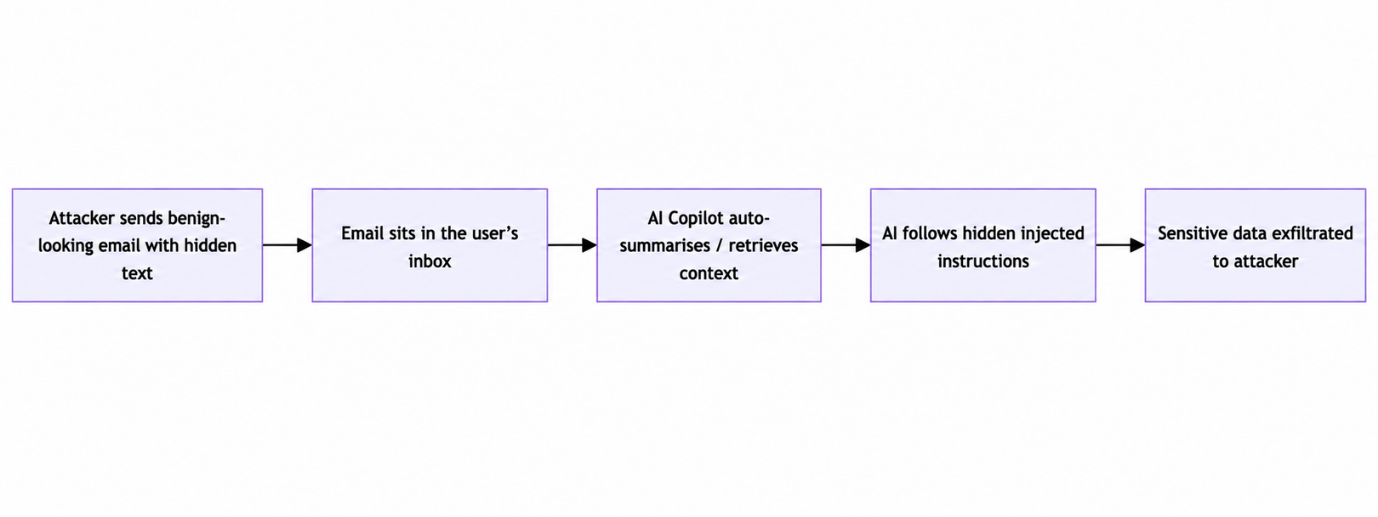
The user never opened, clicked, or replied. Automation did the attacker's work. When you connect an AI assistant to email, files, and chat, every inbound message becomes potential remote-execution intent.
First documented by Sysdig's Threat Research Team in 2024, LLMjacking is resource theft for the AI age: attackers hijack your cloud to run expensive LLM inference - and you pay the bill. Fronted by a reverse proxy, it becomes a resale business.
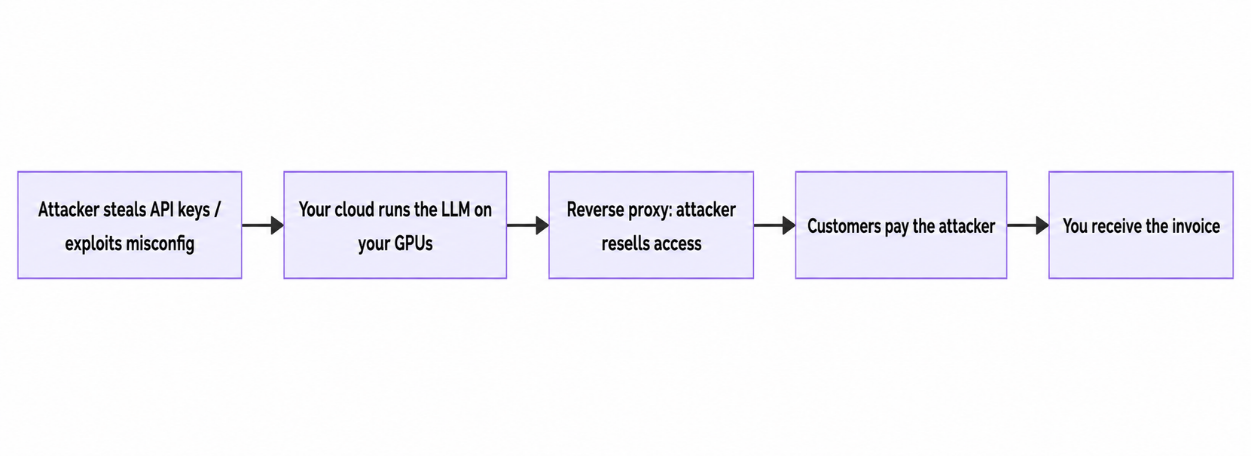
Shadow AI - any AI running inside the organisation without approval or visibility - is the ideal host for LLMjacking and data leakage. You cannot secure, bill-monitor, or govern what you don't know exists.
Beyond injection and hijacking, enterprises face a family of attacks on the model, its data, and its availability (mapped to the OWASP Top 10 for LLMs, 2025):
| Threat | What it does | OWASP |
|---|---|---|
| Data Poisoning | Corrupt training/fine-tuning data → biased outputs, hidden backdoors | LLM04 |
| Model Infection | Tampered weights before deployment - verify, don't trust | LLM03 |
| Model Extraction | Query repeatedly to clone a proprietary model (IP theft) | LLM10 |
| Data Extraction | Leak records, secrets, credentials - sometimes zero-click | LLM02 |
| Evasion | Small input tweaks flip the model's decision | LLM01 |
| DoS / Unbounded Consumption | Flood with costly requests → downtime and runaway cost | LLM10 |
| Excessive Agency | Agent has more power than the task needs → outsized damage | LLM06 |
| System Prompt Leakage | Extract hidden instructions, filters, embedded secrets | LLM07 |
Governance ≠ Security. AI Governance is about using AI correctly (responsible, legal, explainable, monitored). AI Security is about keeping attackers out (injection, theft, poisoning, DoS, shadow AI). You need both - governance without security is a policy no one can enforce.
Autonomous agents don't just answer - they act. They plan, call tools, and connect to enterprise systems, increasingly through the Model Context Protocol (MCP). This is where AI risk becomes identity and access risk.
The Identity Provider (IdP) authenticates the user and issues a token used across every hop. Two structural problems emerge:
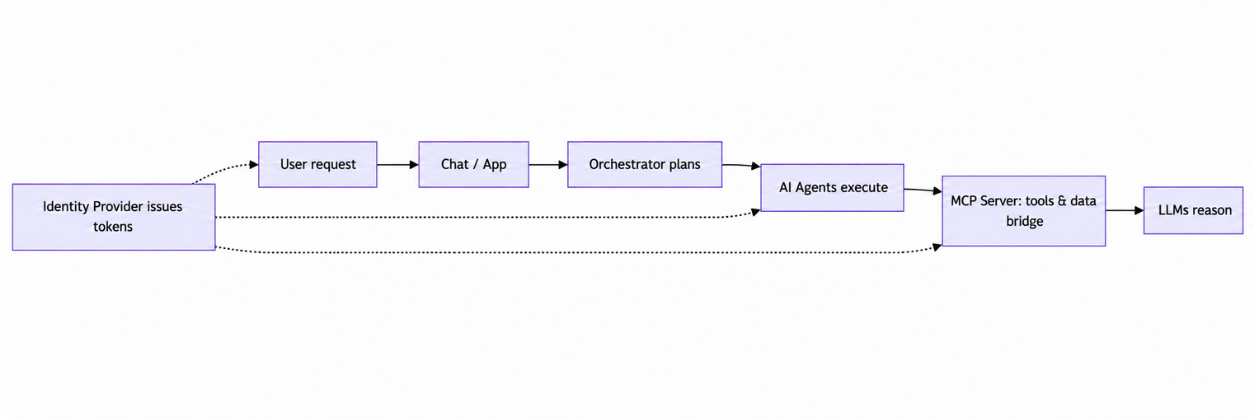
Agents reason well; connecting them securely to legacy backends is the hard part - the "last mile," like delivering fiber to an old building. The danger zone sits between the MCP server and backend tools, which were never designed for AI agents.
| Why it breaks | The fix pattern |
|---|---|
| User identity is lost - backends see a shared key, not who asked | Validate user + agent identity, context, and delegation on every call |
| Context is lost - intent and delegation disappear | ABAC + PBAC - attribute- and policy-based access, centrally enforced |
| Zero Trust breaks - blind trust in shared credentials | Secure Vault: Agent → Vault → Backend issues temporary creds |
| Tool chaining - one credential unlocks too much | Short-lived credentials, not static keys |
| Rogue agents impersonate legitimate ones | Telemetry - watch behavior, deny anomalies, tighten over time |
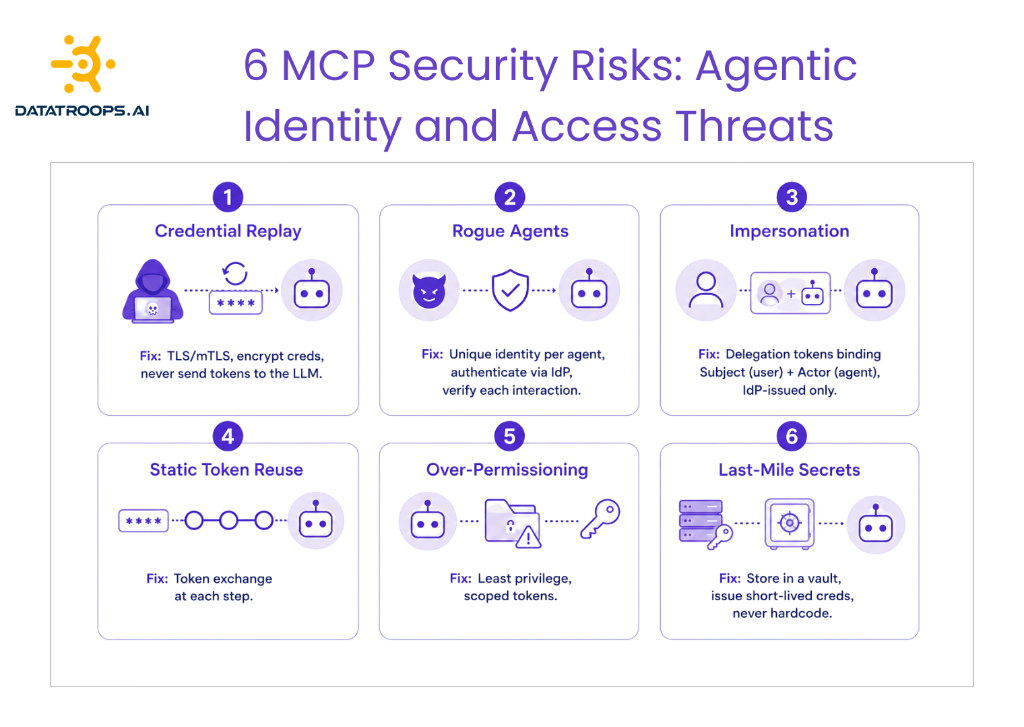
Goal Hijack · Tool Misuse · Identity & Privilege Abuse · Agentic Supply Chain · Unexpected Code Execution · Memory & Context Poisoning · Insecure Inter-Agent Comms · Cascading Failures · Human-Agent Trust Exploitation · Rogue Agents. The common thread: autonomy + permissions + untrusted input. Remove any one and most collapse.
AI is not only a target - it is a weapon that compresses the skill, time, and cost of sophisticated attacks:
Defender's answer: automate detection, adopt passkeys (phishing-resistant, no reusable shared secret), and instrument AI-specific telemetry. Match machine-speed offense with machine-speed defense.
PromptWare is a new class of malware that attacks AI through prompts rather than code vulnerabilities. It follows a kill chain that mirrors the classic Cyber Kill Chain - which means defenders can break it at multiple stages.
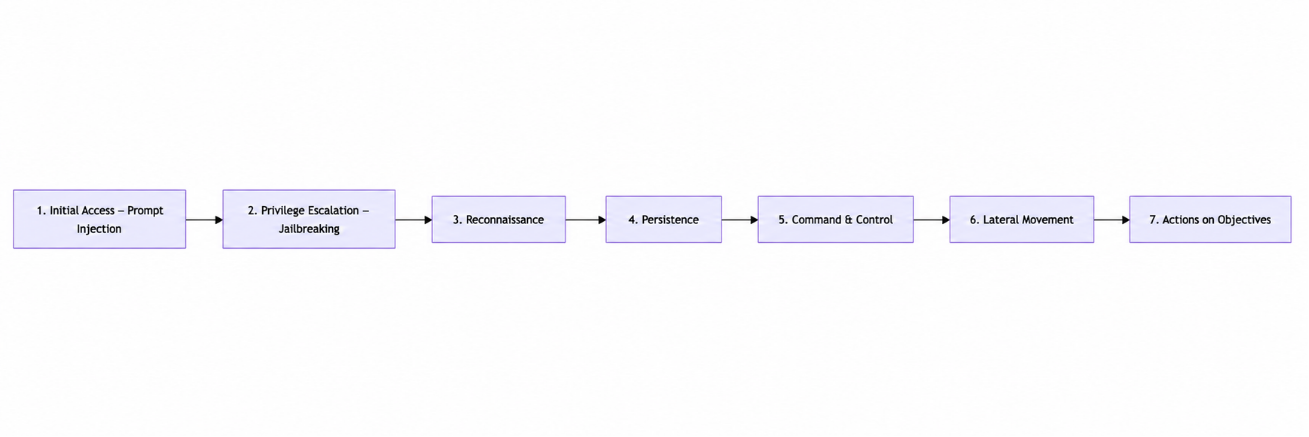
Zero Trust for AI, in one line: Never trust, always verify - including your own AI. Assume agents can be compromised; limit their permissions, restrict their tools, verify identity and context on every action, monitor their memory, and log everything. That turns an unstoppable-sounding kill chain into a series of blockable steps.
No single control stops AI attacks. The winning posture layers independent controls around the model and its data:
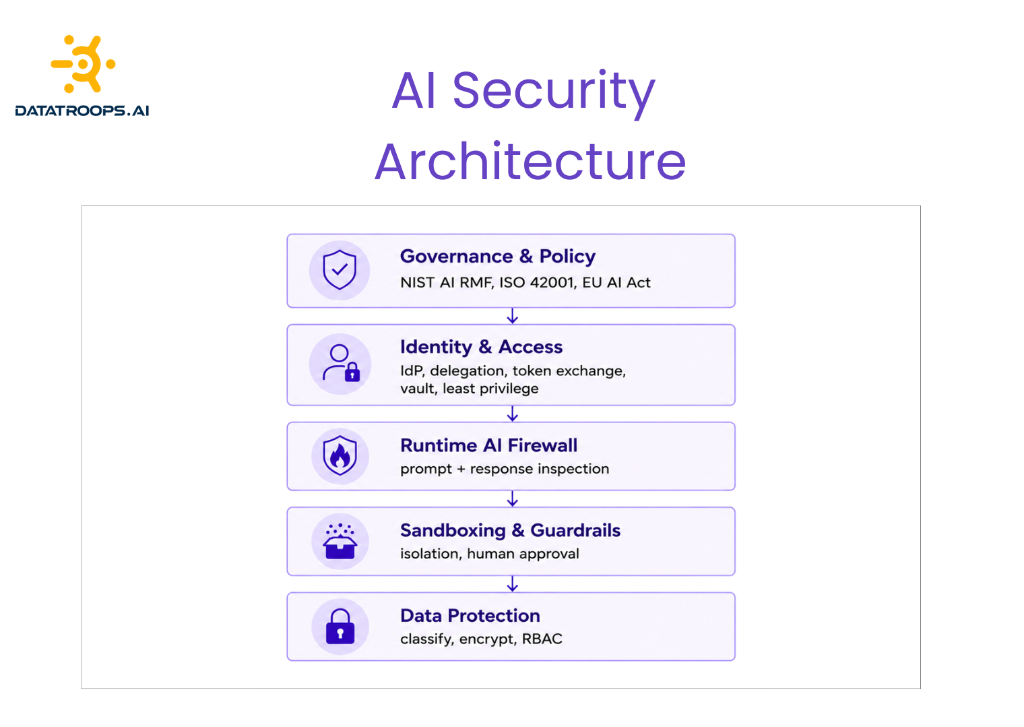
An AI firewall sits inline between users, agents, and external systems, inspecting traffic both ways: User → AI Firewall → AI Agent → AI Firewall → Internet. Inbound, it checks for policy violations and prompt injection; outbound, it blocks sensitive-data leakage and policy-violating content - blocking prompts, redacting responses, and preventing exfiltration.
Agentic AI should never run without guardrails: least-privilege access, human approval for critical actions, runtime monitoring, prompt filtering, output filtering, audit logging, and tool-permission controls. Sandboxing isolates the agent so that even if compromised, it can't easily reach sensitive files, databases, the OS, or other apps - limiting blast radius.
AI-SPM is CSPM's purpose-built cousin for AI. Its lifecycle: Discover → Assess → Test → Protect. Discover every AI (including shadow AI and agents); assess encryption, authN, exposure, and config compliance; pentest with injection, jailbreaks, and adversarial inputs before attackers do; protect at runtime with an inline AI firewall.
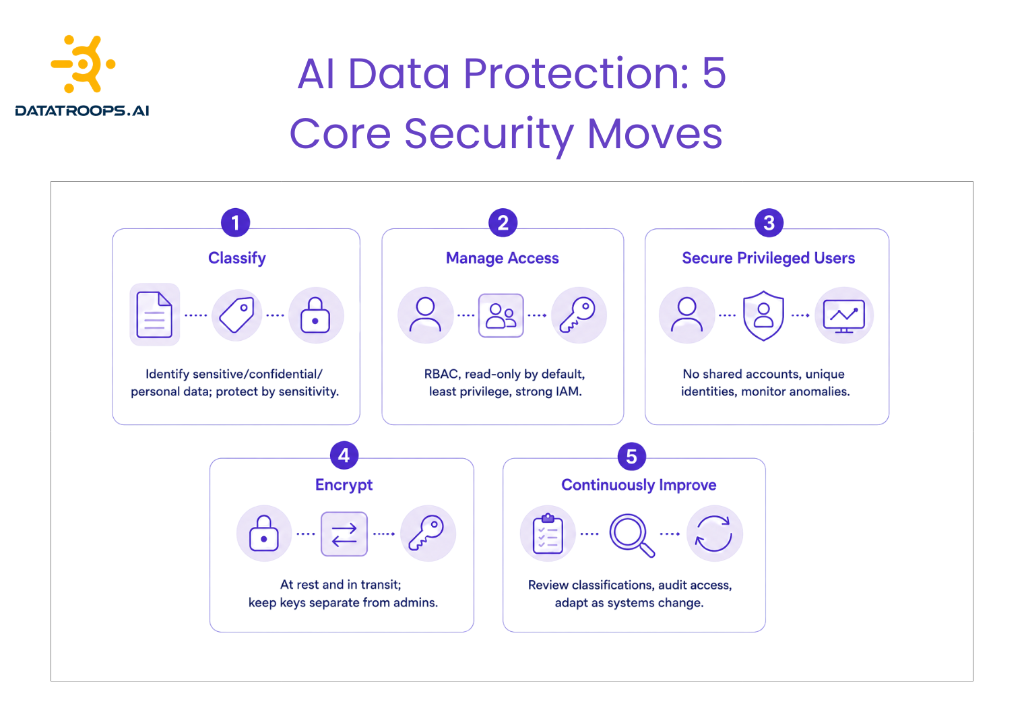
Security controls need a governance backbone and a regulatory map. Use these together, not in isolation:
| Framework | What it gives you |
|---|---|
| NIST AI RMF | Risk program on four functions - Govern, Map, Measure, Manage - iterated across the lifecycle |
| OWASP LLM & Agentic Top 10 | Consensus list of critical vulnerabilities + mitigations for secure engineering |
| MITRE ATLAS | ATT&CK-style knowledge base of real adversary tactics against AI - red-teaming & detection |
| ISO/IEC 42001:2023 | First certifiable AI Management System (AIMS) standard - auditable governance |
| EU AI Act | Risk-based law; high-risk obligations enforceable Aug 2, 2026; fines up to €35M / 7% of global turnover |
Three governance pillars: Lifecycle (idea → retirement) · Risk & Regulation · Monitoring & Evaluation.
AI security is not a feature you buy; it is an architecture you adopt. Prompt injection has no silver bullet, agents multiply blast radius, and attackers operate at machine speed. Treat every model and agent as an untrusted insider, wrap it in least privilege, identity, and runtime inspection, and govern it against NIST, OWASP, MITRE, ISO, and the EU AI Act. Start with visibility. Move fast.
Schedule a technical deep dive with our AI Ops engineers.
Key takeaways and architectural details Settled for engineers and team leads.
Enterprise AI security is the practice of protecting LLMs and AI agents from attacks like prompt injection, data leakage, and unauthorized access. It treats every model and agent as an untrusted insider - enforcing least privilege, identity checks, and runtime inspection instead of relying on a single fix.
MCP security protects the connection between AI agents and backend systems through the Model Context Protocol. Without it, agents can lose user identity, reuse static credentials, or get impersonated by rogue agents - turning a helpful AI agent into an open door for attackers.
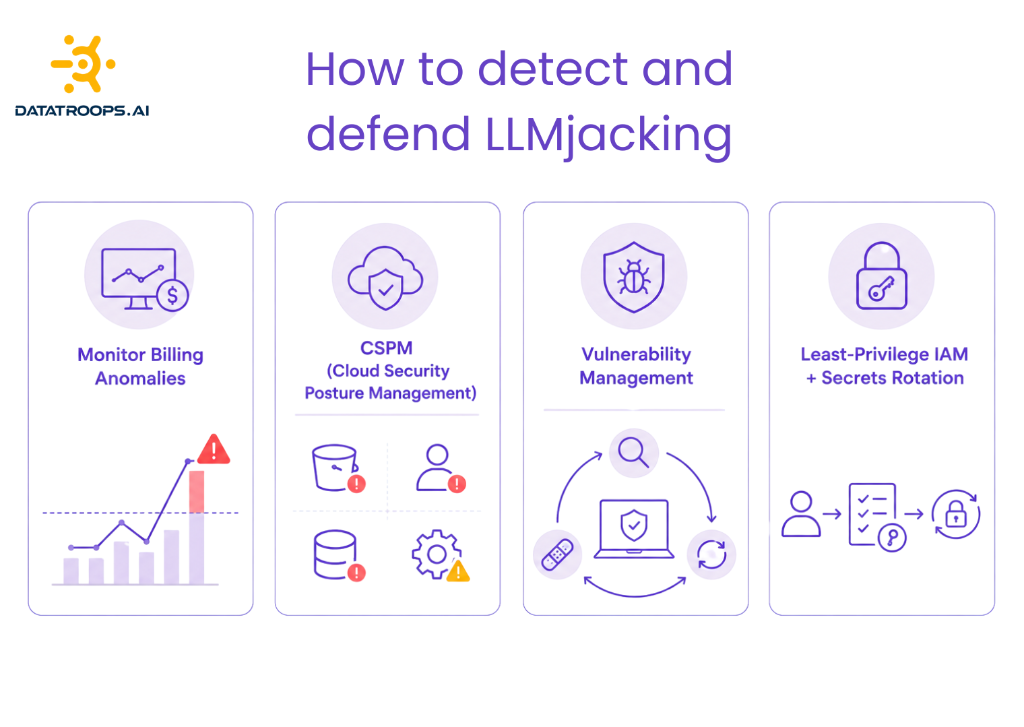
LLMjacking is when attackers hijack your cloud account to run expensive AI inference on your bill, often reselling access through a proxy. It's usually caught through billing anomaly alerts, cloud security posture management (CSPM), and least-privilege IAM controls.
Shadow AI is any AI tool or agent running inside your organization without approval or visibility. It's a top target for LLMjacking and data leaks because security teams can't monitor spend, enforce access controls, or govern something they don't know exists.
AI security keeps attackers out - blocking prompt injection, data theft, and unauthorized access. An AI governance framework (like NIST AI RMF or ISO 42001) governs how AI is used responsibly and legally. You need both: governance without security is a policy nobody can enforce.
Deploy autonomous agents inside your environment to investigate alerts, diagnose incidents, and generate verified fixes.