


AI & Enterprise Technology Content Specialist
"Build vs. buy" oversimplifies the real decision, which actually hinges on three questions: how standard your stack is, how deeply incidents run into that stack's internals, and whether you want to own AI SRE maintenance for the next five years. For teams with complex JVM, Kafka, Spark, or Scala systems, DataTroops offers a third path - custom-tuned agents, deployed in your VPC, run as a managed service.
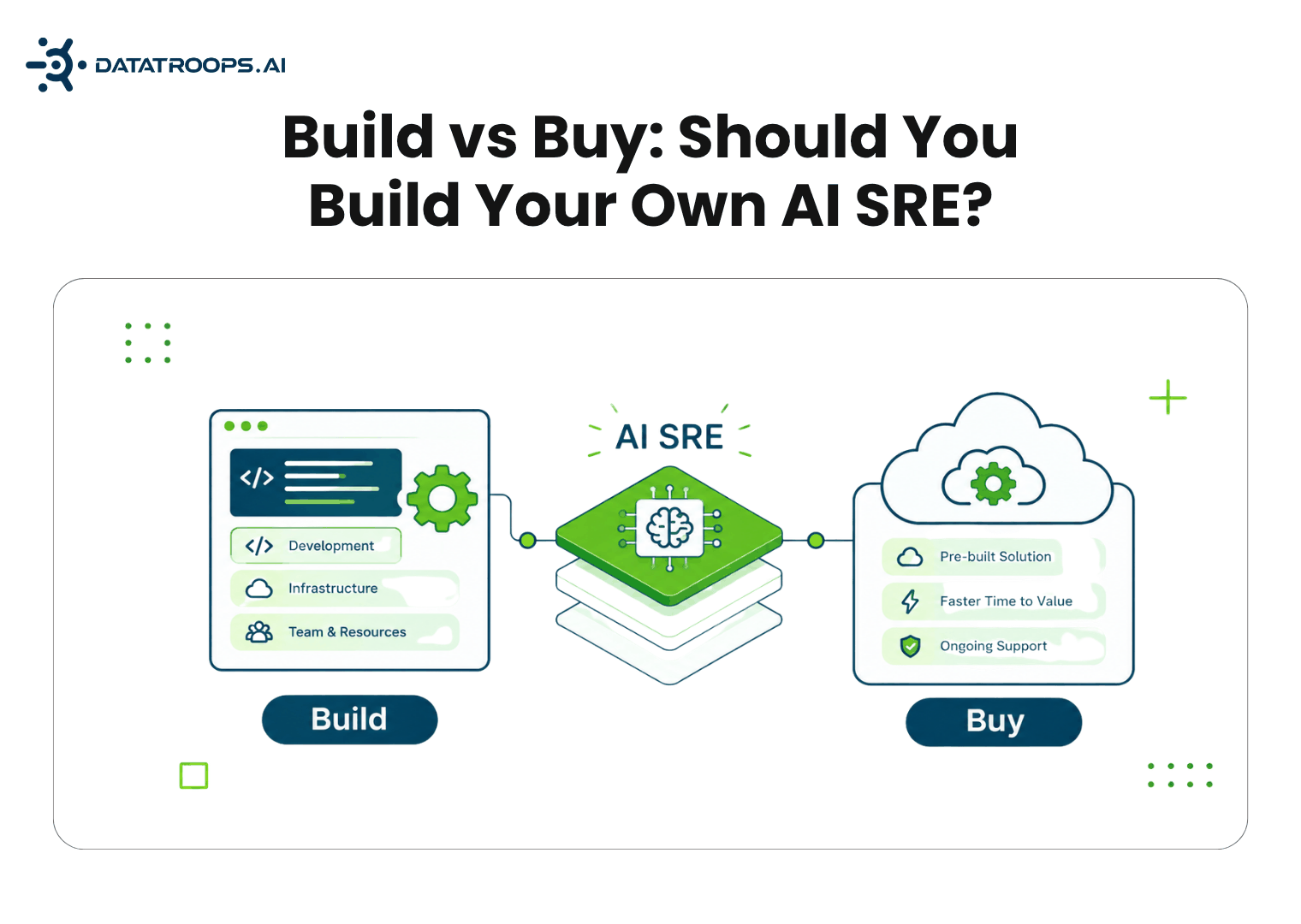
Build vs. Buy: Weighing the trade-offs of building in-house, buying off-the-shelf, or choosing a managed custom AI SRE
For most organizations, the real question isn't build versus buy - it's who owns the ongoing maintenance. Off-the-shelf AI SRE tools work well if your stack looks like everyone else's. But if you're running JVM services, Kafka pipelines, Spark jobs, or custom Scala systems, generic tools stall exactly where your incidents are worst. This guide breaks down the real cost structure behind build vs. buy, when off-the-shelf is the right call, and when a managed, custom-built alternative changes the equation.
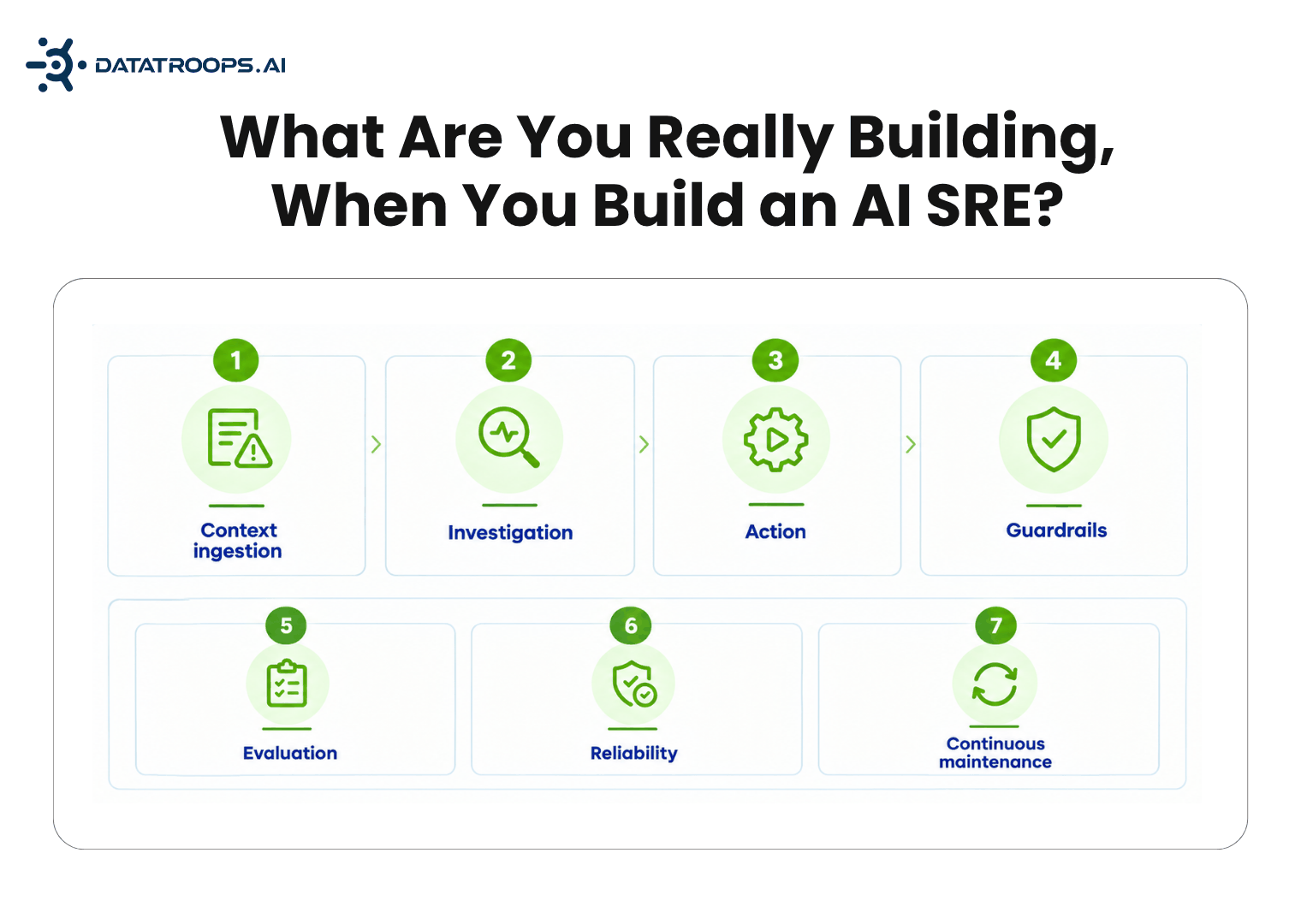
The seven distinct layers required to build an enterprise-ready, production-grade AI SRE
An AI SRE is not an LLM with access to your observability tool. It's a production system with seven distinct layers, and the model call is the easiest one to build.
It's tempting to think of an AI SRE as "point an LLM at Datadog and let it reason." That framing is where most internal projects go wrong. A system that's actually trustworthy at 3 a.m. during a live incident needs:
A weekend prototype can demonstrate one or two of these layers convincingly. Production ownership means all seven, indefinitely - and that's before you factor in what happens when your context ingestion layer has to understand a Kafka consumer lag pattern or a Spark job that's silently degraded, not just a REST service throwing 500s.
Most commercial AI SRE platforms are trained and tuned against generic web-service incident patterns - REST APIs, standard cloud infrastructure, common frameworks. They stall exactly where non-standard, high-throughput systems break.
If your production environment runs on JVM services, Kafka pipelines, Spark jobs, or custom Scala systems, a generic tool's pattern library doesn't map cleanly onto your failure modes. Consumer lag, GC pauses under load, partition rebalancing, backpressure through a Spark job - these aren't edge cases in a trading platform or a payments pipeline, they're the everyday incident. A tool built for "web service returns 500s" has to be re-taught your entire operational vocabulary before it's useful, and most off-the-shelf products simply aren't built to be re-taught that deeply.
This is the specific gap a team with hands-on experience running mission-critical Scala, Rust, and JVM systems - across trading platforms, payment systems, and large-scale data pipelines - is positioned to close, because the agents are tuned against the failure patterns of that stack from the start, not retrofitted after the fact.
Buying gives you speed and predictable cost if your stack is standard. Building gives you full control at a much higher and less predictable cost. A managed, custom-built option gives you the fit of a build without the ownership burden - closer in cost to buying, closer in relevance to building.
| Dimension | Build In-House | Buy (off-the-shelf) | Managed Custom Build |
|---|---|---|---|
| Initial cost | $250K-$500K+ in Year 1 | Predictable subscription | Assessment-based, scoped to your stack |
| Time to value | 6-18 months | Days to weeks | 2-3 weeks for initialassessment, staged rollout after |
| Fit for non-standard stacks (JVM, Kafka, Scala, Spark) | High, if you have the team to build it | Low - trained on generic web-service patterns | High - built and tuned for your specific stack |
| Maintenance burden | High and ongoing, on your team | Handled by vendor | Handled by the managed team - they run and tune the agents |
| Data residency / compliance control | Full control, high effort | Depends on vendor's architecture | VPC-only, zero data egress, or fully self-hosted model |
| Escalation ownership | Your team | Vendor support tier | Managed engineers verify, escalate, or resolve directly |
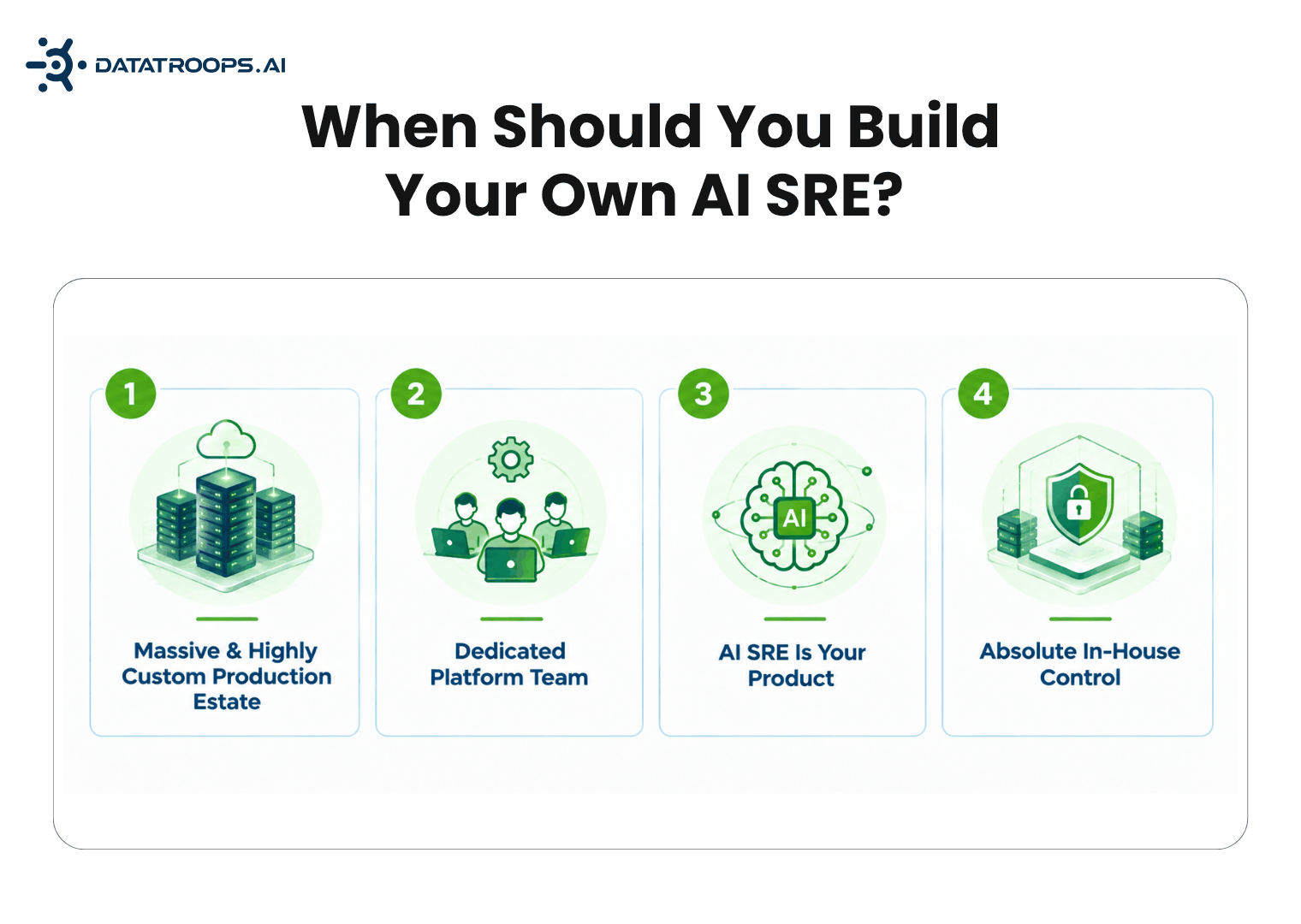
Key criteria when building an AI SRE completely in-house represents the right strategic decision
Building makes sense when reliability intelligence is itself a competitive advantage for you, and you have a team ready to own it indefinitely - not when it's simply an operational nice-to-have.
Good reasons to build entirely in-house include:
If none of these fully describe your situation - particularly if what's actually driving the "build" instinct is that no vendor understands your Kafka/Scala/JVM stack, not that you want to own an engineering team forever - a fully custom build isn't the only way to get that fit.
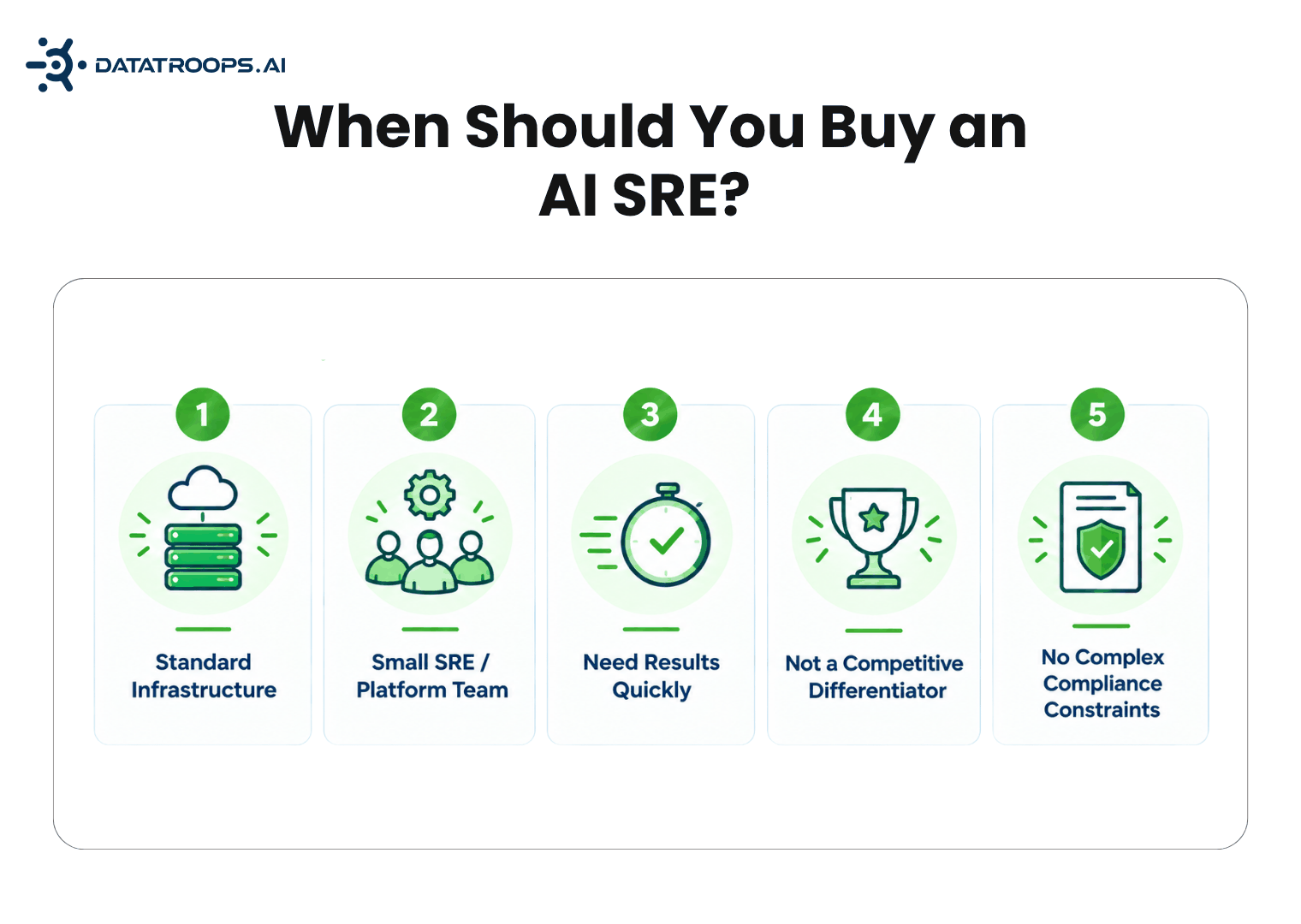
Scenarios where purchasing an off-the-shelf AI SRE tool delivers maximum velocity and value
Buy an off-the-shelf platform when your stack is standard, your team is small, and you need results this quarter without any customization for non-standard infrastructure.
This is the right call when:
Where this breaks down: if your incidents live in Kafka consumer lag, Spark job degradation, or JVM-specific failure modes, a generic platform's out-of-the-box pattern matching won't get you the RCA quality you're expecting - no matter how polished the UI is.
The question that matters isn't whether your engineers can build an AI SRE. It's whether you want to own it for the next five years - or whether you'd rather have a team that's already solved this for stacks like yours own it instead.
Almost any competent engineering team can build a convincing AI SRE prototype in a few weeks. That's not in dispute, and it's exactly why this decision trips people up - the demo works, so the instinct is to keep going.
The real cost shows up after the demo: maintaining integrations as your stack evolves, evaluating model behavior as providers ship new versions, controlling permissions as scope grows, and reconfiguring the system every time your infrastructure changes underneath it. That post-prototype ownership is the actual decision. It doesn't have to default to "your team, forever" or "a generic vendor that doesn't understand your stack." It can be a team that specializes in exactly your kind of system, running the agents and answering the escalations so your engineers don't have to.
Team size, stack complexity, and compliance constraints determine which path fits - teams with standard stacks lean buy, teams with unusual JVM/Kafka/Scala/Spark systems or regulated data lean toward a managed custom build, and only teams with a dedicated long-term platform org should build fully in-house.
| Your situation | Recommendation |
|---|---|
| Small/mid engineering org, standard cloud infrastructure | Buy off-the-shelf |
| JVM, Kafka, Scala, or Spark-heavy stack that off-the-shelf tools misread | Managed custom build |
| Fintech, payments, or other regulated data environment | Managed custom build, VPC-only / zero data egress |
| Large org, highly custom infrastructure, no appetite for a long-term internal AI team | Managed custom build |
| AI/SRE is a core competitive capability for your business | Build strategically, in-house |
And regardless of which path you choose: don't start with autonomous remediation. Start with investigation and root cause analysis, let engineers verify and act on findings, and only automate the steps your historical data shows are consistently reliable.
This is exactly where we fit. Our Production Health Assessment starts by finding out what's actually automatable in your environment before anything goes live - and our Incident Automation Pilot keeps remediation approval-gated, with agents investigating autonomously while engineers verify before any action is taken. If you're ready to move past investigation into ongoing coverage, Managed AI Production Support hands off L1/L2 support entirely while keeping a human in the loop for anything genuinely novel - all deployed inside your own VPC, tuned to stacks like JVM, Kafka, and Scala that generic tools weren't built for.
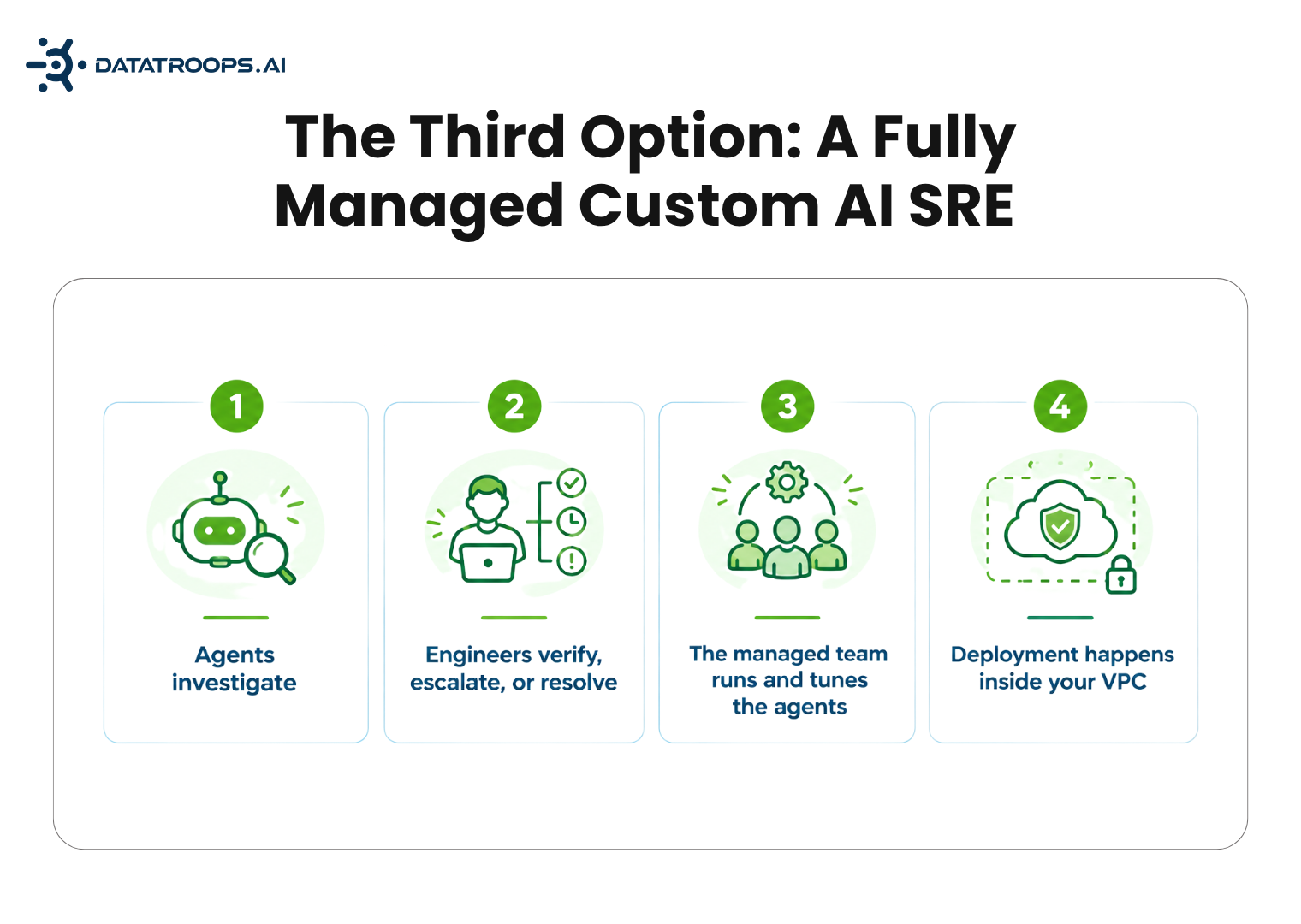
How a fully managed custom AI SRE combines the bespoke precision of in-house build with zero maintenance overhead
Instead of choosing between owning a full build yourself or accepting a generic tool that doesn't understand your stack, a managed custom build gives you agents tuned to your actual infrastructure - run and tuned by a team that does this for a living, not bolted onto your platform team's roadmap.
This is how it plays out in practice:
The pricing logic is straightforward: a managed pod running custom-tuned agents for your stack typically costs less than the L1/L2 support engineers you'd otherwise need to hire - and far less than the ongoing roadmap time a DIY build quietly consumes.
If you're in fintech, payments, or another regulated-data environment, the usual "buy" objection - sending your telemetry through a third party's generic SaaS pipeline - doesn't have to be a dealbreaker for getting AI SRE at all.
A managed custom build can deploy fully inside your VPC, with zero data egress and redacted LLM context by default - or a fully self-hosted model if your compliance requirements demand it. This is meaningfully different from a generic vendor retrofitting a compliance mode after the fact: it's built for regulated environments from the ground up, which matters when your auditors are asking exactly what data left your network and where it went.
Does your data need to stay inside your own walls? If you're in fintech, payments, or another regulated environment, that's not a reason to rule out AI SRE altogether - it's a reason to be specific about deployment model. VPC-only, zero data egress, or a fully self-hosted model should be table stakes in the conversation, not a special request.
Before committing to a build, a buy, or a managed engagement, get a short assessment run against your own systems - not industry benchmarks.
A typical assessment takes 2-3 weeks, needs only read-only API access, and produces numbers from your actual incident history, not a generic case study. Most teams are surprised by what it shows. Some are, frankly, a little horrified. The point isn't to sell you on a specific path - it's to replace the industry-benchmark numbers in this guide with your own, so the build-vs-buy decision is based on your real MTTR, your real incident volume, and your real cost of downtime.
Structure it in stages with a real exit point after each one, so you're never locked into more than you've validated:
"Build vs. buy" is the wrong frame if it makes you think there are only two boxes to choose from. In practice, the decision comes down to three separate questions, and most teams get an answer to all three before they've finished reading a vendor's pricing page:
Is your stack standard, or does it look like a trading floor, a payments pipeline, or a Kafka-and-Spark data platform? If it's standard web-service infrastructure, an off-the-shelf AI SRE tool will likely do the job well, quickly, and cheaply. If your worst incidents are consumer lag, GC pauses, or a Spark job silently degrading, a generic pattern library was never going to catch those - no matter how good the demo looked.
Do you actually want to own this for five years, or do you want the fit of a custom build without becoming the team that maintains it forever? Building in-house is the right call for a small number of teams - ones where reliability intelligence is genuinely the product, and there's a dedicated org ready to carry it indefinitely. For everyone else, "we need something custom" doesn't have to mean "we need to hire and maintain our own AI infrastructure team." It can mean handing the build and the ongoing tuning to a team that's already solved this for stacks like yours.
That's exactly the gap we built DataTroops to close. Instead of asking you to choose between a generic tool that won't understand your stack and an in-house build you'll be maintaining forever, we deploy custom-tuned AI SRE agents - built for JVM, Kafka, Spark, and Scala systems - inside your own VPC, and run them as a managed service. You get the fit of a custom build, without becoming the team that must keep it alive.
Book a 30-minute architecture review to map out your incident automation, build vs. buy evaluation, and custom agent deployment.
Key takeaways and architectural details Settled for engineers and team leads.
No. AI SRE agents are built to take investigative labor off your engineers, not replace their judgment - reading logs, traces, and metrics to surface a likely root cause, while engineers verify, escalate, or resolve. The goal is fewer 2 a.m. pages that turn into hours of manual log correlation, not fewer engineers.
A working prototype can take days to weeks. A production-grade system typically takes 6-18 months, and that doesn't include the maintenance that follows - which for most teams becomes a permanent cost, not a one-time project.
Building in-house typically runs $250K-$500K or more in year one, with maintenance often exceeding that within a couple of years. Off-the-shelf buying is a predictable subscription but may underperform on non-standard stacks. A managed custom build is scoped to your assessment results, and is typically priced against what you'd otherwise pay to hire dedicated L1/L2 support engineers - usually less.
Generally not well out of the box. Most commercial platforms are trained on generic web-service incident patterns and stall on consumer lag, GC pauses, partition rebalancing, and other failure modes specific to JVM-based and data-pipeline systems. Tools tuned specifically for those stacks perform meaningfully better on exactly the incidents that matter most in trading, payments, and data-pipeline environments.
Yes, if the deployment model is built for it. Look for VPC-only deployment with zero data egress, redacted LLM context by default, and the option of a fully self-hosted model - this satisfies compliance requirements that a generic multi-tenant SaaS tool typically can't.
Read-only API access and roughly 2-3 weeks. No production changes, no commitment beyond the assessment itself - the output is a set of numbers from your own incident history that you can use to decide between building, buying, or a managed engagement.
Deploy autonomous agents inside your environment to investigate alerts, diagnose incidents, and generate verified fixes.