


AI & Enterprise Technology Content Specialist
AI for production systems goes beyond traditional DevOps automation. While DevOps focuses on automating deployments, infrastructure, and repetitive workflows, AI for production systems helps investigate incidents, correlate telemetry, identify root causes, and support real-time operational decisions. This blog explains the key differences, where each approach fits, and how AI can extend production operations without replacing the engineering teams responsible for them.
DevOps automation and AI for production systems solve different operational problems. DevOps automation executes deterministic rules for known scenarios, such as deployments, scaling, infrastructure provisioning, and predefined runbooks. AI for production systems analyzes live context across logs, metrics, traces, deployments, dependencies, and incident history to help investigate situations that were not fully scripted in advance. The two are not replacements for each other. The safest production model is usually AI for investigation, deterministic automation for execution, and humans in control of high-risk decisions.
DevOps automation uses human-authored rules, workflows, scripts, and infrastructure-as-code to perform repeatable tasks consistently. It is the foundation of modern software delivery and production operations.
Common examples include:
The strength of DevOps automation is predictability. When the inputs and environment are controlled, the workflow is designed to produce a consistent result.
Its limitation is equally important: deterministic automation only handles the scenarios that people anticipated and encoded. If three subsystems interact in an unexpected way, or a failure does not match an existing rule, the workflow may stop, escalate, or require a human to investigate.
AI for production systems is an AI-assisted operational layer that interprets live production context, correlates signals, generates investigation hypotheses, and recommends or performs tightly controlled actions.
Instead of asking only whether a condition matches a predefined rule, the system can help answer:
AI for production systems may support:
The important distinction is that AI output should be treated as a hypothesis or recommendation, not as unquestionable truth. Production systems still need verification, deterministic controls, and human judgment for high-impact actions.
| Dimension | DevOps automation | AI for production systems |
|---|---|---|
| Primary logic | Human-authored rules and workflows | Model-assisted interpretation of operational context |
| Best at | Repeating known tasks consistently | Investigating complex or ambiguous situations |
| Typical inputs | Pipeline state, configuration, thresholds, and schedules | Logs, metrics, traces, deployments, dependencies, tickets, runbooks, and incident history |
| Response to novelty | Stops, escalates, or requires a new rule | Can generate hypotheses from related patterns |
| Output consistency | High when inputs and environment are controlled | Variable; requires evidence, validation, and guardrails |
| Main value | Fast and repeatable execution | Faster context gathering, triage, and investigation |
| Main risk | Incorrect or incomplete rules | Incorrect inference, hallucinated recommendations, or model drift |
| Execution model | Directly runs approved workflows | Should recommend or invoke allowlisted workflows |
| Human role | Defines rules and handles exceptions | Validates hypotheses and approves higher-risk actions |
| Maintenance | Update scripts, thresholds, and workflows | Improve context, evaluate outputs, update policies, and monitor drift |
AI should not replace deterministic automation where the correct behavior is already known and must be executed consistently.
DevOps automation remains the better choice for:
These workflows benefit from deterministic behavior, version control, testing, auditability, and predictable rollback.
AI can still assist by selecting the relevant runbook, explaining the change, checking context, or identifying an unusual condition. However, the execution itself should remain inside hardened and policy-controlled automation.
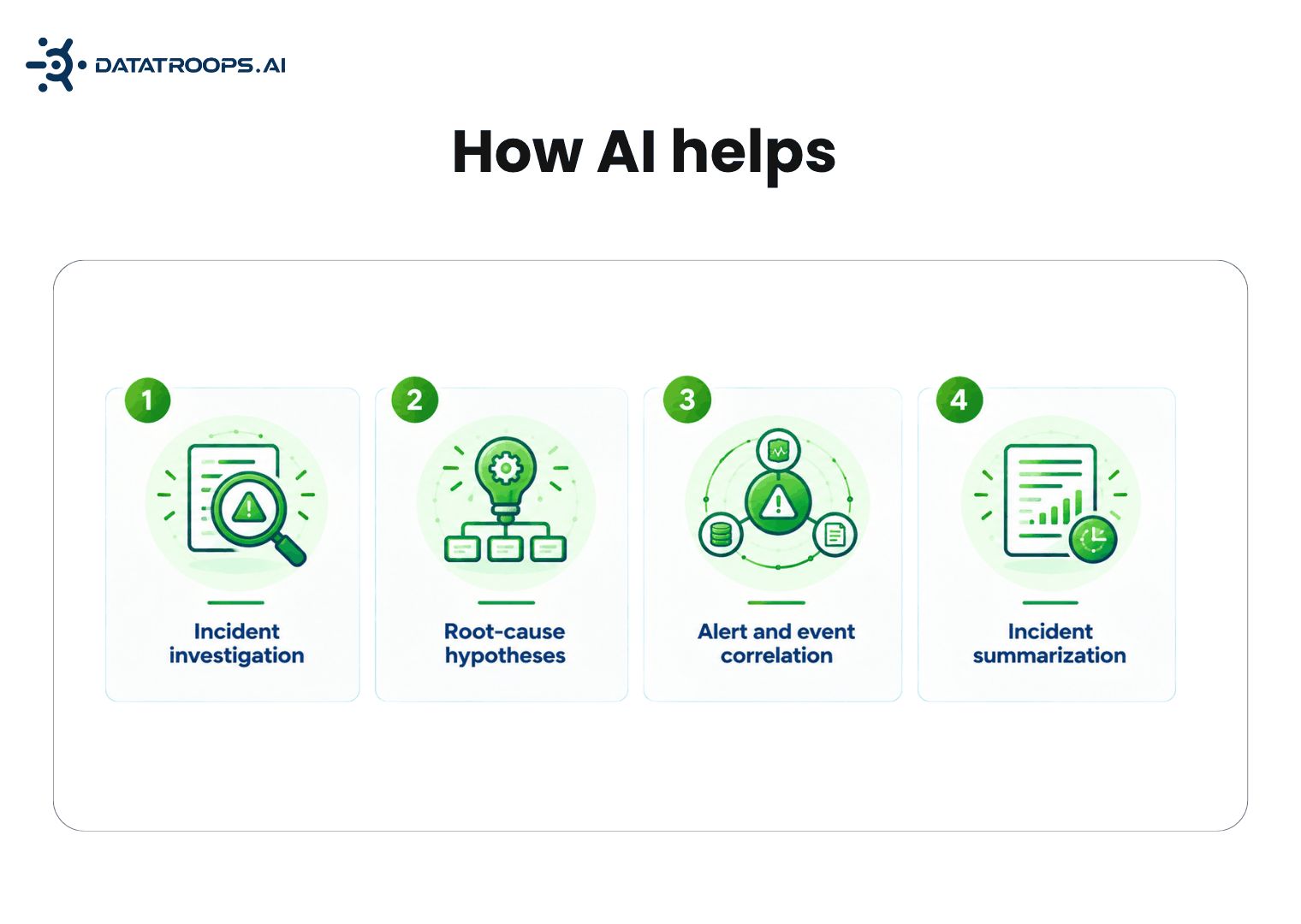
AI is most useful where the problem is not simply executing a known step but understanding a changing situation.
Incident investigation During an incident, relevant context is often distributed across multiple tools. An engineer may need to connect:
AI can reduce the time required to collect and organize that context. It can also present a set of possible explanations for human review.
Root-cause hypotheses AI can compare current signals with historical incidents and identify patterns that may not be obvious from a single dashboard. However, the result should be labelled as a hypothesis and supported with evidence.
A reliable system should show:
Alert and event correlation AI can help group related alerts and distinguish a likely primary incident from downstream symptoms. This can reduce duplicate investigation and help responders focus on the most relevant dependency path.
It should not silently suppress alerts without defined policies, review, and monitoring for missed incidents.
Incident summarization AI can produce a first-pass incident summary from timelines, chat messages, tickets, and telemetry. A human should review the summary before it becomes an official incident record or postmortem.
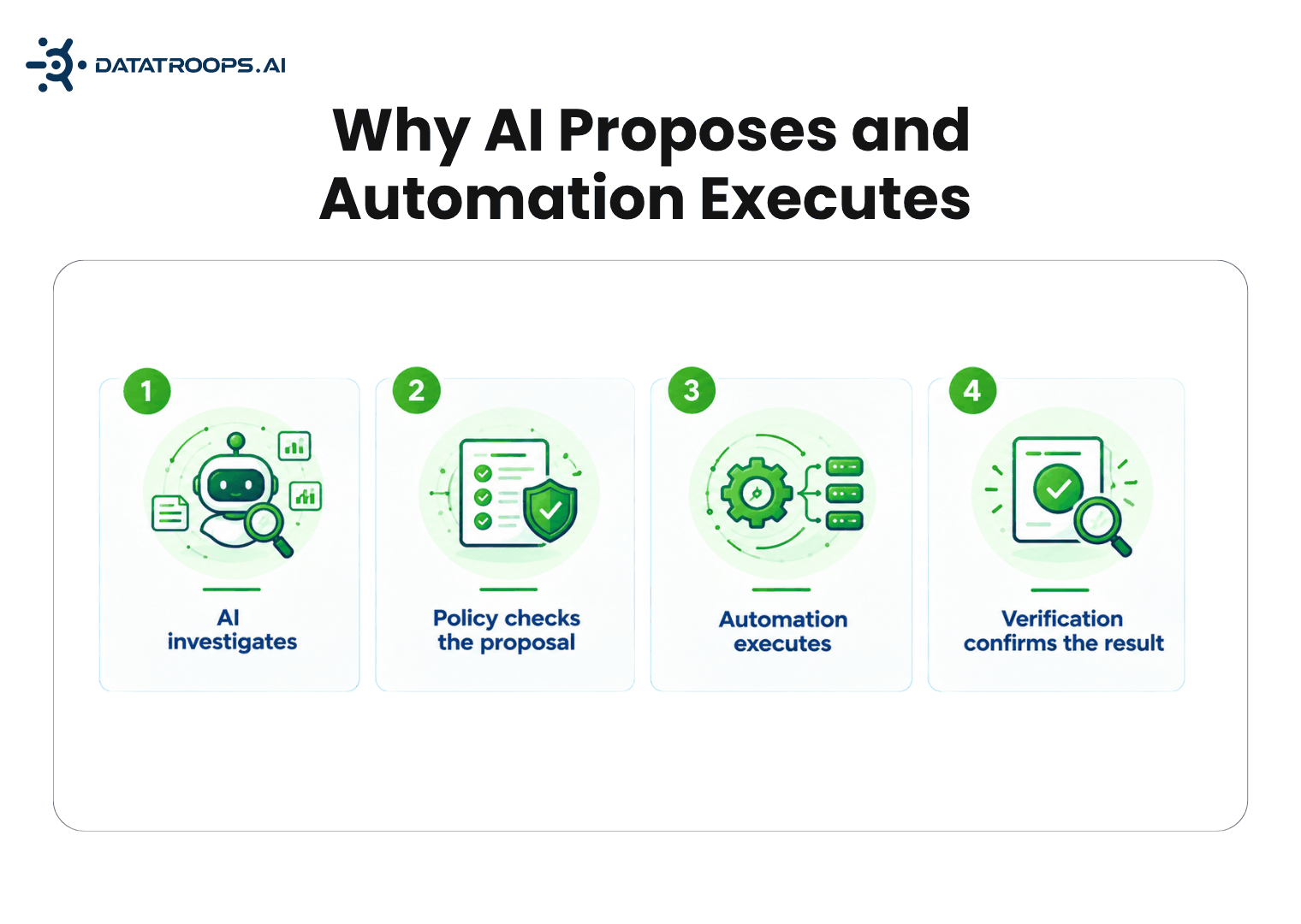
The safest production architecture separates interpretation from execution.
1. AI investigates The AI gathers relevant telemetry, checks recent deployments, maps dependencies, retrieves runbooks, and compares the current incident with historical patterns.
2. Policy checks the proposal Deterministic controls evaluate:
3. Automation executes If the action is permitted, an approved runbook or hardened deployment workflow applies the change. The AI should not receive unrestricted shell access or open-ended authority to generate and execute arbitrary commands.
4. Verification confirms the result The system checks whether the expected outcome occurred. If verification fails, it should stop, escalate, or execute a documented rollback.
The model is responsible for interpreting context and proposing a path. The policy and execution layers are responsible for deciding what is permitted and applying it safely.
Google's published work on agentic SRE describes progressive authorization and controlled autonomy rather than granting agents unrestricted production access. Microsoft's guidance similarly emphasizes deterministic controls, least privilege, scoped tools, and approval for high-risk or irreversible actions.
AI can be useful in production, but its output is probabilistic and may be wrong, incomplete, or overconfident.
Hallucinated recommendations A model may produce a plausible root cause or command that does not match the actual system state. The recommendation should therefore include supporting evidence and should pass through a deterministic policy layer before any state-changing action.
Prompt injection through telemetry Logs, tickets, chat messages, and error strings may contain malformed or adversarial content. They should be treated as untrusted data, not as instructions.
A safe design should:
Model drift and changing systems Production environments change. Services are added, dependencies are replaced, traffic patterns evolve, and runbooks become outdated.
AI performance should therefore be evaluated continuously using:
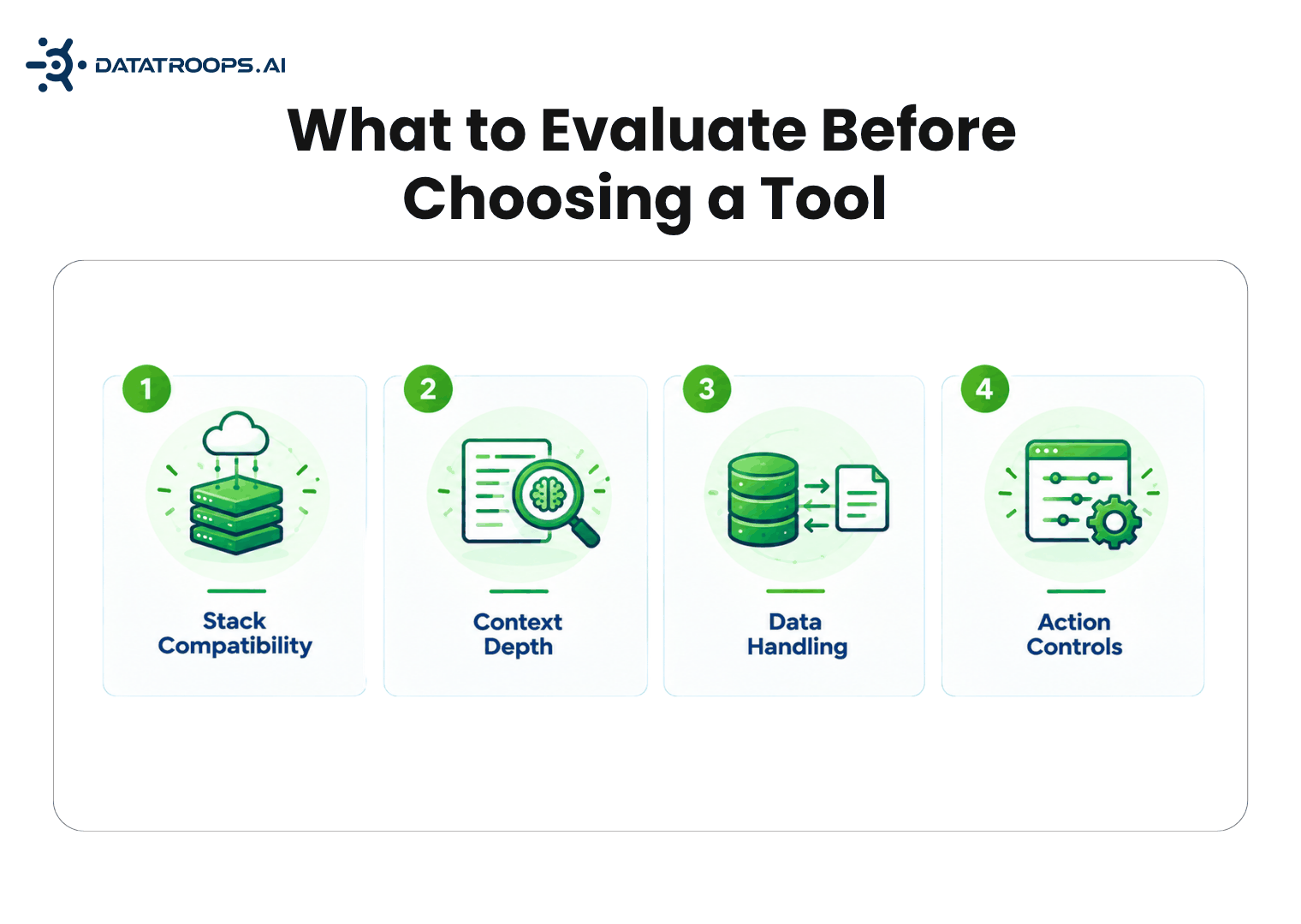
A useful evaluation should go beyond a product demo.
Ask whether the system can work with:
The relevant question is not whether the product supports Kubernetes. It is whether it can investigate the failure modes that actually affect your environment.
Check whether the system can connect:
Ask:
Verify whether the system supports:
NIST's AI Risk Management Framework and Generative AI Profile provide a broader governance framework for identifying and managing AI risks. Microsoft's agent guidance also recommends minimum necessary permissions, scoped tools, deterministic controls, auditability, and approval for high-impact actions.
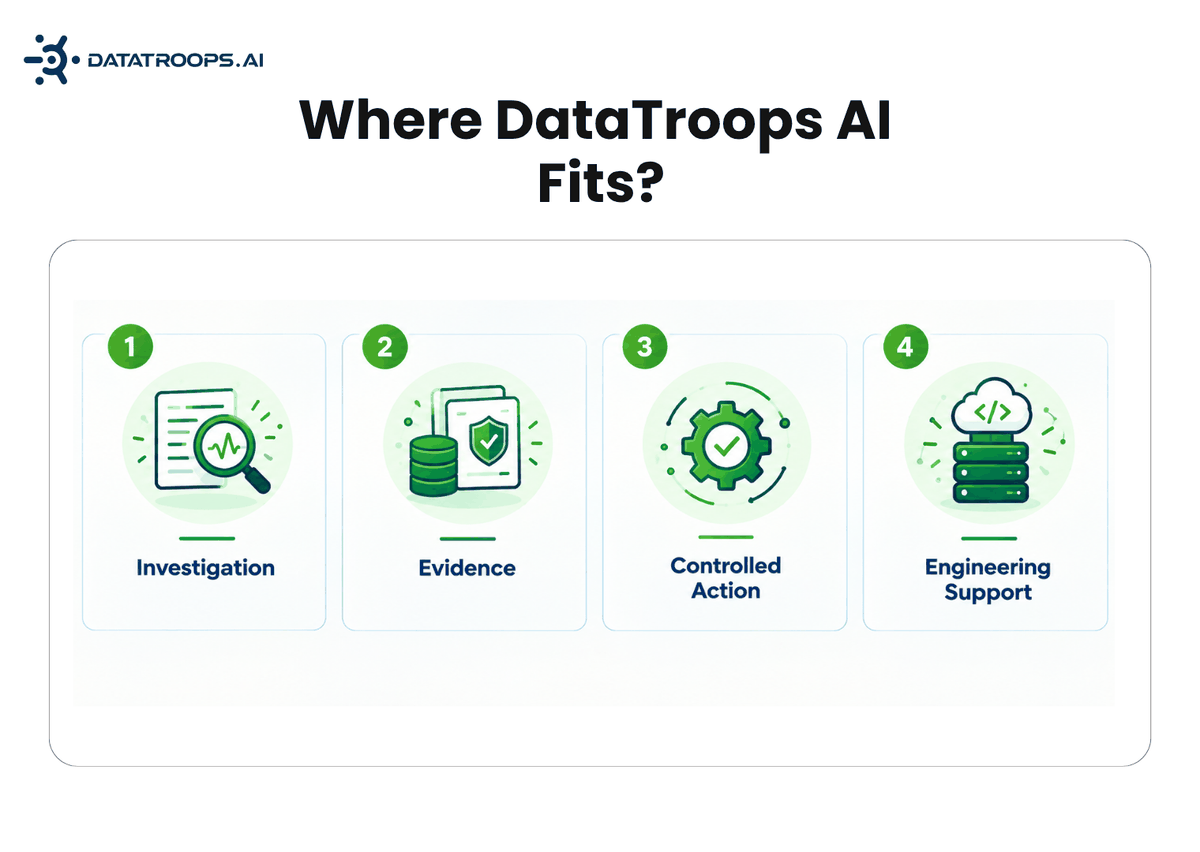
DataTroops helps engineering teams apply AI to production investigation without replacing the observability tools or engineering processes they already use.
The approach combines AI investigation agents with experienced production engineers.
Investigation Agents connect relevant logs, metrics, traces, deployments, dependencies, runbooks, and incident history to help investigate production issues.
Evidence Findings are presented with supporting operational context so engineers can review the hypothesis rather than relying on an unexplained recommendation.
Controlled action Remediation is governed by approvals, permissions, allowlisted workflows, and verification steps. The AI does not replace the policy or execution layer.
Engineering support Complex or novel incidents can be escalated to experienced production engineers when they require deeper system knowledge or judgment.
DataTroops is particularly relevant for teams operating complex JVM, Kafka, Scala, Spark, Rust, or distributed-system environments, and for organizations with strict requirements around production data handling.
Teams can start with a Production Health Assessment to understand where incident-investigation time is being spent, which patterns recur, and which workflows may be safe to automate. If the assessment identifies suitable opportunities, the next step can be a scoped Incident Automation Pilot, followed by Managed AI Production Support where appropriate.
All product, deployment, security, performance, and compliance claims should be reviewed by the DataTroops product and legal teams before publication.
Deploy AI investigation agents alongside your existing DevOps automation to speed up incident triage while keeping deterministic controls and human approval in place.
Key takeaways and architectural details Settled for engineers and team leads.
No. DevOps automation remains responsible for deterministic workflows such as deployments, infrastructure changes, scaling policies, and tested rollbacks. AI can add an interpretation and investigation layer above those workflows.
The terms overlap, but they are not always used in exactly the same way. AIOps traditionally refers to AI-assisted IT operations, event correlation, anomaly detection, and alert management. AI for production systems is a broader or newer framing that may include incident investigation, software and deployment context, dependency analysis, and controlled remediation.
It depends on your stack, operational workflows, and data constraints. When evaluating a tool, check whether it understands your failure modes, integrates with your existing systems, supports your deployment model, and provides evidence that engineers can verify. Teams operating JVM, Kafka, Scala, Spark, or other complex distributed systems should ask vendors to demonstrate those environments using realistic incident scenarios rather than generic web-service examples.
The split varies by incident and organization. In many teams, diagnosis and context gathering consume a substantial share of resolution time, but the actual proportion should be measured from the team's own incident history. A Production Health Assessment can help establish that baseline and identify which recurring investigation activities may be suitable for automation.
DataTroops can begin with a scoped [Production Health Assessment](/products/production-health-assessment) using read-only access. The assessment is designed to establish a baseline from the customer's own systems before deciding whether an [Incident Automation Pilot](/products/ai-powered-incident-automation-pilot) or [Managed AI Production Support](/products/managed-sre-services) is appropriate. Get a [Production Health Assessment](/products/production-health-assessment) from DataTroops.ai to get started.
Deploy autonomous agents inside your environment to investigate alerts, diagnose incidents, and generate verified fixes.